
What if the small water stain on your ceiling isn’t just a cosmetic eyesore, but a silent countdown to a major structural disaster? It’s natural to feel a sense of hesitation or even anxiety when you spot a potential issue overhead. You might worry about being overcharged for a minor fix or feel confused about whether you should contact your insurance provider before picking up the phone. Knowing exactly when to call a roofer for repair is the difference between a simple maintenance task and an expensive, full-scale replacement that could have been avoided with the right timing.
We’re here to help you navigate these decisions with the confidence of a seasoned expert. You’ll learn how to identify the critical signs of damage that require immediate attention, such as compromised shingles or hidden moisture traps common in our harsh New England climate. This guide also breaks down how the March 2026 insurance rule changes regarding “Actual Cash Value” might affect your coverage and your wallet. By the end, you’ll have a clear checklist of “must-call” signs and a better understanding of how early professional intervention preserves your property’s integrity and long-term value.
Key Takeaways
- Identify the “critical threshold” where temporary fixes fail to protect your home’s structural integrity and professional intervention becomes a necessity.
- Understand how unique New England weather patterns, such as coastal winds and ice dams, dictate exactly when to call a roofer for repair to prevent hidden moisture damage.
- Apply the “40% Rule” to determine whether a targeted repair is a sound investment or if a full replacement provides better long-term financial security.
- Master the strategic three-step sequence—Inspect, Document, File—to navigate the insurance process with confidence and clarity.
- Learn why treating your roof as a comprehensive system rather than a collection of shingles is the key to maintaining your property’s value and safety.
Recognizing the Critical Threshold for Professional Roof Repair
Every roofing system eventually reaches a critical threshold. This is the precise moment when minor aging transforms into a structural vulnerability that threatens your home’s safety. While many homeowners are comfortable with basic DIY tasks, true roof maintenance involves more than just swapping out a single shingle. It’s about preserving the entire assembly. A professional roofer acts as a diagnostic expert, looking past the surface to evaluate the underlying components that keep your family dry. By understanding your roof’s function as an integrated system, you can better appreciate how the underlayment, decking, and ventilation work in harmony to protect your investment.
Ground-level observations often miss what we call “latent damage.” These are issues like softened decking, microscopic cracks in flashing, or compromised seals that aren’t visible until a technician is physically on the surface. If you wait until the damage is obvious from the street, you’ve likely already crossed the line into costly structural repairs. Professional roofers don’t just provide labor; they provide a comprehensive analysis of your home’s thermal envelope. Knowing exactly when to call a roofer for repair before these invisible issues escalate is the hallmark of a proactive, wise homeowner.
Visible Exterior Indicators That Demand Action
Your roof’s exterior serves as the first line of defense against the elements. When this shield begins to fail, the signs are often physical and unmistakable if you know where to look. We recommend a seasonal visual check to catch these issues early:
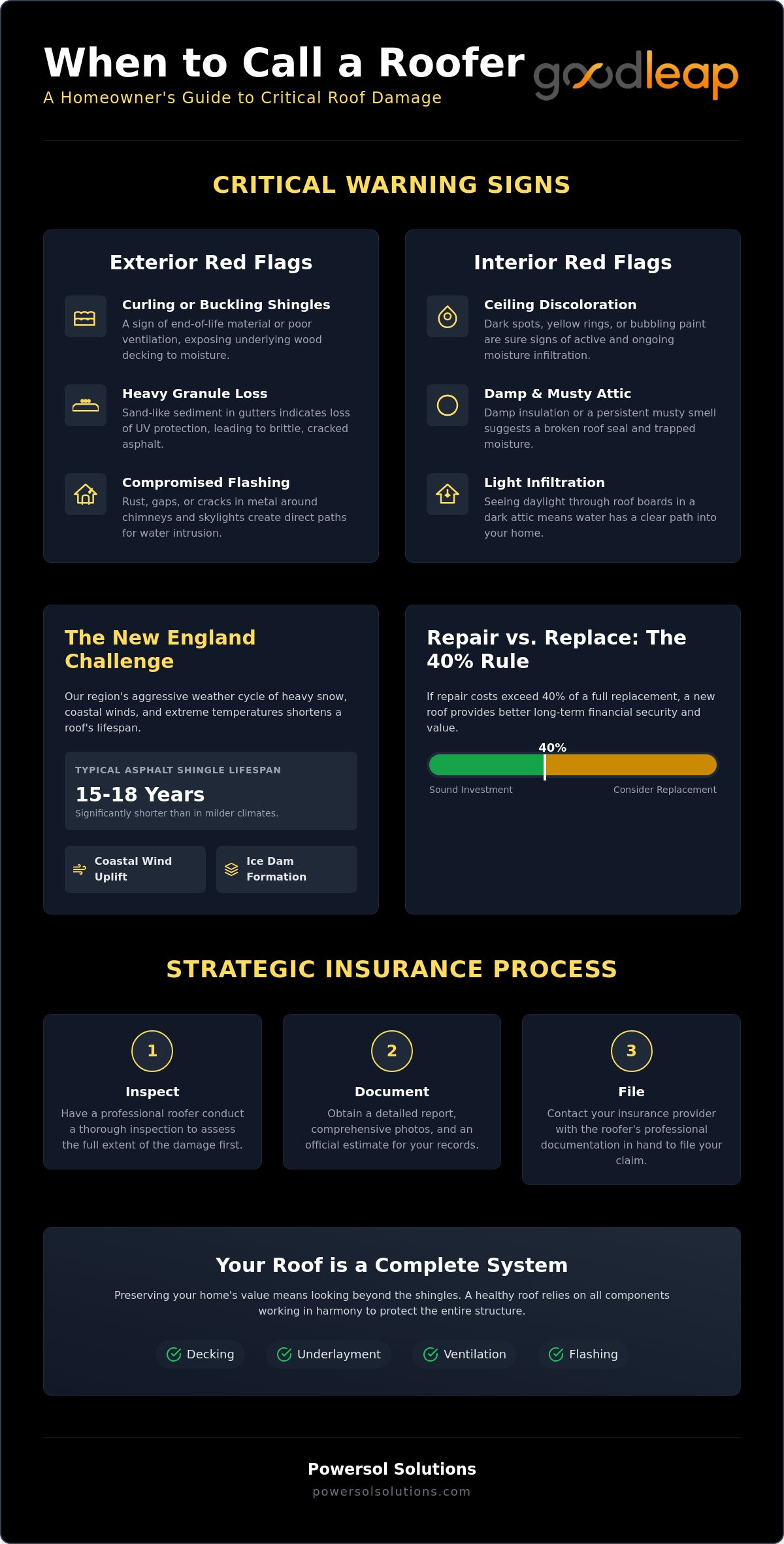
- Curling or Buckling Shingles: This is a sign that the material has reached the end of its service life or is reacting to poor attic ventilation. It leaves the wood decking beneath completely exposed to rain.
- Heavy Granule Loss: Finding sand-like sediment in your gutters means your shingles have lost their UV protection. Without these granules, the asphalt becomes brittle and cracks under the sun’s heat.
- Compromised Flashing: Rust, gaps, or cracks in the metal around chimneys and skylights create direct pathways for water to enter your home’s frame.
Subtle Interior Red Flags in Your Attic and Ceilings
The most reliable evidence of a failing roof often hides inside your home. By the time a leak reaches your living room, the damage has been occurring for weeks or even months. Understanding when to call a roofer for repair requires a quick trip to the attic with a flashlight to look for these red flags:
- Ceiling Discoloration: Dark spots, yellow rings, or bubbling paint on your upper-floor ceilings are sure signs of active moisture infiltration.
- Attic Atmosphere: Check for damp insulation or a persistent musty smell. These indicators suggest that the roof’s seal is broken and moisture is trapped in your home’s structure.
- Light Infiltration: If you see “stars” or pinpricks of daylight through the roof boards while standing in a dark attic, water can and will follow that same path during the next storm.
Evaluating Storm Damage and Seasonal Wear in New England
Homeowners in Boston, Brockton, and Quincy face a set of environmental stressors that most national roofing guides simply overlook. Our region’s weather isn’t just varied; it’s aggressive. The average lifespan of asphalt shingles in the Northeast is typically 15 to 18 years, which is notably shorter than in milder climates. This accelerated aging is due to the relentless cycle of heavy snow, coastal winds, and the extreme temperature fluctuations that define Massachusetts living. Determining when to call a roofer for repair often comes down to understanding how these local elements interact with your home’s specific architecture.
High winds along the Massachusetts coast do more than just rattle windows. They create significant uplift that can break the factory-applied adhesive seals on your shingles. Once a seal is broken, the shingle becomes a “sail,” allowing rain to be driven directly onto the underlayment. Similarly, hail damage is a subtle culprit. Even small hailstones can cause “bruising,” which are microscopic fractures in the asphalt layer that strip away protective granules. This exposure to UV rays leads to premature brittleness and eventual failure. If your neighborhood has recently weathered a severe storm, scheduling a professional assessment with Powersol Solutions is a strategic move to catch these issues before the next season arrives.
Post-Storm Assessment: Wind and Debris
After a Nor’easter, safety should be your primary concern. You don’t need to climb a ladder to find trouble. Use binoculars to scan for lifted shingles or sections that appear “puffy” or uneven. These are signs that the wind has compromised the attachment points. Look for “bruising” on shingles, which appears as dark, circular indentations where granules have been knocked away. You should also check for tree limb strikes. Even if a branch didn’t crash through the roof, the impact can cause hidden structural fractures in the decking that only a professional eye can detect.
The Impact of Ice Dams and Heavy Snow Loads
Winter presents the greatest challenge to New England roofs. Ice dams occur when heat escaping from your attic melts snow on the upper roof, which then refreezes at the colder eaves. This ridge of ice traps meltwater, forcing it upward and under your shingles. This moisture eventually rots the fascia boards and saturates your insulation. Proactive roof maintenance for homeowners is the best defense against this cycle. By ensuring your ventilation and insulation are balanced, you reduce the temperature differences that cause dams to form. Knowing when to call a roofer for repair during a heavy snow cycle can prevent a minor ice dam from turning into a full interior renovation.
Repair vs. Replacement: Making the Most Cost-Effective Choice
Deciding whether to patch a leak or invest in a full system overhaul is one of the most significant financial choices a homeowner will face. To simplify this process, we utilize the “40% Rule.” If the cost of a comprehensive repair exceeds 40% of the total cost for a new installation, it’s often more fiscally responsible to opt for a replacement. While a targeted repair can successfully extend a roof’s life by an additional 3 to 5 years, this only holds true if the underlying structure remains sound. Knowing exactly when to call a roofer for repair versus when to prepare for a full project depends heavily on whether the damage is localized or systemic.
Localized damage, such as a few shingles torn away by a fallen limb, is usually a prime candidate for repair. However, if you notice widespread issues across multiple slopes, the damage is likely systemic. In these cases, pouring money into repetitive fixes becomes a cycle of diminishing returns. Our goal is to act as your trusted partner, helping you identify the point where repairs stop being a solution and start becoming a temporary bandage on a larger problem. We focus on long-term reliability rather than high-pressure sales, ensuring your investment is durable and wise.
Assessing Shingle Condition and Roof Age
Shingle fatigue is a reality in our demanding climate. While national averages suggest longer lifespans, the harsh freeze-thaw cycles in the Northeast mean asphalt shingles typically average 15 to 18 years of reliable service. As shingles age, they become brittle and lose their flexibility. This brittleness makes repairs nearly impossible because the act of lifting one shingle to fix another can cause the surrounding materials to crack. If your roof is approaching this age range, or if it already has two layers of shingles, which is the maximum permitted by Massachusetts building code, a roof replacement in Massachusetts is often the only viable path forward.
Calculating the ROI of a Targeted Repair
A professional repair does more than just stop a drip; it protects the other high-value components of your home’s exterior. By addressing a roofing issue early, you prevent moisture from seeping into your siding or damaging your window frames. This proactive approach maintains your curb appeal and preserves your home’s resale value. Additionally, insurance companies are increasingly scrutinizing roof age and condition. Ignoring minor damage can lead to limited coverage or non-renewal of your policy. Understanding when to call a roofer for repair ensures you maintain your property’s eligibility for full protection and prevents the “deductible dilemma” from becoming a major financial burden later. When planning for the future, selecting high quality roofing materials rated for New England’s demanding conditions can significantly extend the intervals between repairs and maximize your return on investment. Homeowners who are also evaluating their home’s complete weather envelope may want to consult with trusted vinyl siding contractors in Boston to ensure their exterior cladding provides the same level of thermal protection as a properly maintained roof.
Navigating the Process: Should You Call a Roofer or Insurance First?
Many homeowners reflexively call their insurance agent the moment a storm passes or a leak appears. While this seems logical, it can be a strategic error. Instead, we recommend a clear 1-2-3 sequence: Inspect, Document, and then File. A professional assessment tells you if the damage actually warrants a claim. It’s often wiser to understand the full scope of work before involving an insurance adjuster. If the cost to fix a few shingles is lower than your deductible, filing a claim only serves to potentially increase your future premiums without providing any financial relief. Knowing when to call a roofer for repair before contacting your carrier protects your claims history and your financial interests.
The “deductible dilemma” is a common hurdle for Massachusetts residents. If your deductible is $1,000 but the repair estimate is $850, filing a claim creates a permanent record on your policy for zero payout. Additionally, the March 2026 FHFA rule change allows lenders to accept Actual Cash Value (ACV) policies. This means if you have an older roof, your insurance company might only pay the depreciated value rather than the full cost of a modern repair. A local expert who understands these shifting standards acts as your advocate, ensuring you don’t walk into a claim blindfolded. For a detailed assessment that you can take to your insurance agent, request a comprehensive roof assessment today.
The Benefits of a Professional Inspection Before Filing a Claim
A professional roofer acts as a technical advocate during the claims process. While an insurance adjuster’s primary role is to evaluate the company’s liability, a local contractor focuses on the home’s structural integrity. Their detailed report provides the leverage you need during negotiations. It also helps you avoid “frivolous claims” that occur when damage is merely cosmetic or results from lack of maintenance rather than a covered peril. Your contractor will identify all signs of a leaking roof, including moisture levels in the decking that a standard visual adjustment might overlook.
Complying with Policy Requirements and Documentation
New England insurance policies often include “mitigation of damages” clauses. This means you are legally obligated to prevent further damage once an issue is discovered. A professional roofer can provide temporary protection, such as tarping, that fulfills this requirement while the claim is pending. Be wary of “storm chasers” who appear after a Nor’easter. These out-of-state entities often push for immediate claims without a thorough inspection of your home’s specific needs. A local partner understands Massachusetts building codes and can help you navigate denied or underpaid claims by providing evidence-based rebuttals and clear photographic proof.
Securing Your Home with Powersol Solutions’ Expert Repair Services
Powersol Solutions stands as the bridge between a vulnerable roof and a secure home. We have spent over a decade protecting properties across Boston and the South Shore, developing a deep understanding of how our local environment tests a building’s exterior. We recognize that knowing exactly when to call a roofer for repair is only the first step in a larger journey of home preservation. Choosing a partner who values your property’s long-term integrity is what truly transforms a simple fix into a lasting investment. Our team doesn’t just apply surface-level patches; we conduct a forensic-level diagnostic to ensure every repair addresses the root cause of the issue, preventing recurring costs and hidden damage.
We are committed to providing durable roofing solutions that are specifically engineered to withstand the unique pressures of the Massachusetts coastline. From the initial inspection to the final walkthrough, our focus remains on precision and transparency. We believe in building long-term partnerships with our clients, serving as a reliable guide through every seasonal challenge. This methodical approach ensures that your home remains a sanctuary, regardless of what the New England forecast holds. By focusing on the “journey” of homeownership, we take the burden of coordination off your shoulders, allowing you to focus on the pride of a well-maintained home.
Our Local Standards for Massachusetts Homes
Our expertise extends deep into the specific building codes and environmental requirements of Stoughton, Holbrook, and Quincy. We ensure every project complies with strict local regulations regarding ice and water shields, underlayment, and proper attic ventilation. By utilizing high quality roofing materials designed for maximum wind and ice resistance, we provide a level of protection that generic contractors often overlook. Our local presence is a significant benefit for homeowners, as it ensures prompt warranty support and the long-term reliability that only a community-vested partner can provide.
The Powersol Partnership: From Inspection to Protection
We’ve eliminated the typical stress of home maintenance by adopting a communication style that is direct, honest, and entirely free of high-pressure sales tactics. When you schedule your professional roof assessment, you receive a clear, documented overview of your roof’s health and a logical plan for any necessary intervention. We’re here to provide the expert advice you need to make an informed decision for your family’s safety. Knowing when to call a roofer for repair shouldn’t be a source of anxiety. Our closing promise is simple: we protect your home with the same meticulous care and obsessive attention to detail as if it were our own.
Secure Your Home’s Future with Proactive Care
Protecting your home’s integrity is a continuous journey that requires both vigilance and professional expertise. By understanding the “40% rule” for financial decisions and recognizing the subtle red flags in your attic, you’ve taken the first step toward avoiding costly, premature replacements. Knowing when to call a roofer for repair is about more than just reacting to a leak; it’s about making a strategic investment in your property’s long-term value. Acting early prevents the cumulative wear of New England weather from compromising your home’s thermal envelope.
Powersol Solutions offers over 10 years of dedicated New England roofing experience, specializing in the complex storm damage and ice dam prevention needs of Massachusetts homeowners. As local experts serving Boston, Brockton, and the South Shore, we take pride in being your trusted partner for a durable and secure roof. We focus on meticulous craftsmanship and transparent communication to ensure your peace of mind throughout every season. You don’t have to navigate these technical decisions alone. We’re here to provide the clarity and protection your property deserves.
Protect your home today—schedule a professional roof inspection with Powersol Solutions
Common Questions About Roof Repair in Massachusetts
How much does a typical roof repair cost in Massachusetts?
The total investment for a professional repair depends on several technical variables rather than a fixed flat rate. Factors such as the specific roofing material, the pitch or steepness of your roof, and the overall accessibility of the damaged area all influence the final estimate. A steep roof requires specialized safety equipment and more labor hours, while high end materials like slate or metal involve different precision techniques compared to standard asphalt shingles.
Can I repair a roof leak myself?
Attempting a DIY roof repair carries significant risks that often outweigh the initial savings. Beyond the obvious physical safety hazards of working at heights, many manufacturers will void your material warranty if the work isn’t performed by a licensed professional. Improperly sealed shingles or flashing can trap moisture against your home’s wood decking, leading to accelerated rot that remains hidden until it becomes a structural emergency.
How long does a roof repair usually take?
Most minor professional repairs are completed within a single day. The total timeframe depends on the severity of the damage and whether the underlying roof deck has been compromised by moisture. If your project requires custom fabricated flashing or specialized materials that aren’t immediately in stock, the process might extend slightly. We always prioritize securing your home against the elements before we leave the site.
What happens if I ignore a small roof leak?
Ignoring a minor leak is a recipe for expensive structural failure. Moisture that enters through a small gap quickly saturates your insulation, reducing your home’s energy efficiency and creating a breeding ground for mold. Over time, this water infiltration rots the rafters and ceiling joists, potentially compromising the safety of your entire household. Understanding exactly when to call a roofer for repair at the first sign of moisture prevents these cascading interior disasters.
Will insurance cover roof repairs caused by old age?
Standard homeowners insurance policies are designed to cover sudden and accidental damage, such as impact from a fallen tree or high wind events. They generally don’t cover repairs necessitated by gradual wear and tear or simple aging. If your shingles have reached the end of their functional lifespan, the responsibility for maintenance typically falls on the homeowner. A professional inspection can help you distinguish between storm related damage and age related deterioration.
How do I know if my roofer is legitimate?
Verifying a contractor’s legitimacy involves checking for a valid Massachusetts license and active insurance coverage. A reputable local expert should provide recent references from your community and offer transparent, written estimates rather than verbal quotes. We recommend reviewing these 45 essential questions to ask a roofing contractor to ensure your chosen partner has the expertise and integrity required to protect your home.