
The most expensive roof you’ll ever buy is the one you have to install twice because a contractor cut corners or ignored a critical structural detail. It’s completely natural to feel a sense of anxiety when you’re preparing for a project of this scale, especially with the technical jargon and the fear of hidden costs that often plague the industry. To ensure your home remains a sanctuary against the harsh New England elements, you need more than just a quote; you need a rigorous vetting process. Mastering the specific questions to ask a roofing contractor is the only way to separate the true craftsmen from the “storm chasers” who disappear after the first heavy snowfall.
We believe your home is your most significant investment, and you deserve the peace of mind that comes with a durable, professionally installed system. This comprehensive checklist provides a clear framework to navigate your contractor interviews with absolute confidence. We’ll guide you through verifying 2026 licensing standards, understanding the latest safety requirements, and confirming that your project meets the strict Massachusetts Building Code for ice and water shields. From initial credentials to long-term performance, this guide ensures you have every tool necessary to hire a partner who values your home’s integrity as much as you do.
Key Takeaways
- Verify that a contractor holds both CSL and HIC registrations to ensure they meet specific legal requirements for residential work in Massachusetts.
- Use our comprehensive list of questions to ask a roofing contractor to identify who will actually be on-site supervising your project every day.
- Learn why standard national roofing techniques often fail in New England and how to confirm your installer uses proper ice and water shield protection.
- Understand the critical distinction between manufacturer material warranties and long-term workmanship coverage so you don’t leave your investment unprotected.
- Master the “Red Flag” checklist to distinguish between a dedicated local craftsman and a high-pressure salesperson before signing any contracts.
Verify Their Legal Standing: Licensing and Insurance Questions
Hiring a professional for a major home improvement requires more than just checking a box. When you are refining your list of questions to ask a roofing contractor, the most critical inquiries involve their legal authority to work on your property. In Massachusetts, a vague claim of being “licensed” is often insufficient. The state requires two distinct registrations to protect your home and your financial interests, and a truly professional partner will be eager to prove they meet these high standards.
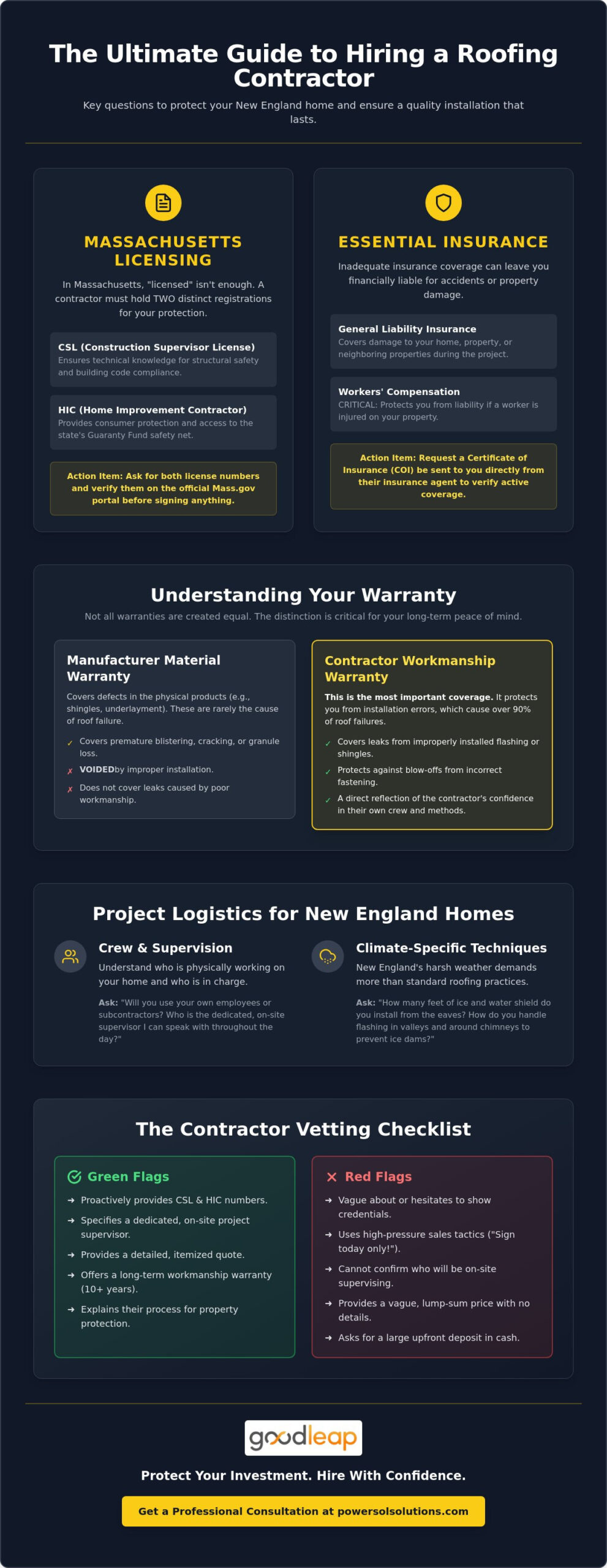
The Massachusetts Construction Supervisor License (CSL) is a mandatory requirement for structural roofing work, serving as proof that the individual in charge has the technical knowledge to manage a safe and code-compliant installation. A “Green Flag” answer during your interview is when a contractor provides digital PDFs or physical copies of both their CSL and HIC registration without being prompted. Conversely, any hesitation to provide these documents is a major “Red Flag” that suggests they might be operating outside of legal boundaries, leaving you vulnerable to poor workmanship and legal liability.
The Massachusetts Credential Checklist
Ask: “What is your HIC registration number and CSL license number?” Understanding the difference between these two is vital for your protection. The CSL ensures structural safety and compliance with building codes, while the Home Improvement Contractor (HIC) registration is centered on consumer protection. Maintaining an active HIC registration allows you to access the state’s Guaranty Fund, which acts as a financial safety net if a contractor fails to fulfill their obligations. Verify these numbers immediately through the official Mass.gov portal to confirm they are current and in good standing before you sign any agreements.
Insurance Coverage Specifics
Ask: “Do you carry both General Liability and Workers’ Compensation insurance?” Gaining a deeper understanding of what a roofing contractor does involves recognizing the inherent risks of working at heights. While General Liability covers damage to your property, it does not protect you if a worker is injured on your site. If a contractor lacks Workers’ Compensation, you could potentially be held liable for medical expenses or lost wages. Always request a Certificate of Insurance (COI) sent directly from the insurance agent to your email. This direct communication ensures the policy is active and hasn’t been altered, providing you with the security you need to move forward with your project.
Project Logistics: Questions About the Workday and Site Safety
Once you have confirmed the legal credentials, it’s time to focus on the daily reality of the job site. A roof replacement is a major construction event, not just a simple repair, and the logistics of the workday determine whether the experience is seamless or stressful. When refining your questions to ask a roofing contractor, you must identify who is actually responsible for the work happening above your head. Many companies use a hierarchy where a project manager handles the scheduling while a crew leader directs the technical installation. A major “Green Flag” in this industry is the presence of a dedicated, on-site supervisor who speaks your language fluently and remains on your property throughout the day to ensure quality control and clear communication.
While regional codes vary, reviewing CSLB’s Tips for Hiring a Roofing Contractor offers a universal standard for the level of professionalism you should expect during the construction process. You deserve a partner who treats your property with the same respect they would their own home, which starts with a clear plan for site safety and organization.
Crew Management and Subcontracting
When finalizing your questions to ask a roofing contractor, don’t overlook the specifics of who will be doing the heavy lifting. Ask: “Will you be using your own employees or a subcontracted crew?” If a contractor uses subcontractors, it’s vital to ask how long they’ve worked together and what their vetting process involves. A team that has collaborated on hundreds of projects will have a rhythm and standard of excellence that a temporary crew simply cannot match. You should also establish a clear communication plan from day one. Ask: “Who is my primary point of contact if I have a concern at 3:00 PM on a Tuesday?” Having a direct line to a decision-maker prevents small misunderstandings from turning into significant project delays.
A contractor’s operational efficiency is often reflected in how they manage their essential equipment and logistics. For instance, many thriving service companies scale their mobile operations and maintain a professional presence by partnering with Alliance Fleet Solutions for their commercial vehicle needs.
This commitment to efficiency often extends to digital infrastructure as well; many forward-thinking organizations leverage IntellifyAi to implement intelligent automation that streamlines enterprise-wide data management and decision-making.
Site Protection and Cleanup Standards
Ask: “How will you protect my siding, windows, and flower beds during the tear-off?” Thousands of pounds of old shingles and nails will come off your roof, and without proper shielding, your exterior can suffer significant damage. If you’re also researching finding professional window installers in MA, you already know that protecting your home’s glass and frames is a top priority. Inquire about where the dumpster will be placed and what measures are taken to prevent it from cracking your driveway. Using a high-powered magnetic sweep across the lawn and driveway at the end of every day is the only effective way to prevent stray nails from causing flat tires or injuries. If you want to ensure your home is in expert hands, explore our detailed site protection protocols before you make your final hiring decision.
Climate-Specific Technical Questions for New England Homes
A roof that thrives in the mild winters of Florida will likely fail during a brutal Massachusetts Nor’easter. Our region’s unique combination of heavy snow loads, freeze-thaw cycles, and high humidity requires a specialized approach to installation. When refining your questions to ask a roofing contractor, you must move beyond basic aesthetics to probe their understanding of local climate stressors. A “Red Flag” response is a contractor who claims they “just do it the standard way” without mentioning specific upgrades for ice dam prevention or high-wind resistance. In contrast, a “Green Flag” partner will provide a detailed explanation of how they integrate eave protection and ridge ventilation to defend your home’s structural integrity. Investing in durable roofing solutions tailored for 2026 weather patterns is the only way to ensure your protection lasts for decades rather than just a few seasons.
Ice Dam Prevention and Flashing
Ask: “How many rows of Ice and Water Shield will you install at the eaves?” While the Massachusetts building code requires this protective underlayment to extend at least 24 inches inside the interior warm wall line, high-performance best practices often dictate two full rows for homes with deep overhangs. This extra layer of security prevents melting snow from backing up under shingles and causing interior water damage. After a harsh winter storm, even a few displaced shingles can compromise this protection, which is why understanding the full scope of roof shingle repair in MA is essential before damage escalates into a larger structural problem. You should also ask: “Will you replace all flashing, or just reuse the old lead and copper?” Reusing old flashing is a major technical failure. Metal fatigues over time; replacing it ensures every transition point on your roof remains watertight and resilient against the elements.
Ventilation and Attic Health
Ask: “Will you perform a ventilation calculation for my specific attic square footage?” A healthy roof needs to breathe. If your contractor doesn’t calculate the exact balance between intake and exhaust, you risk “over-ventilating,” which can draw rain or snow into the attic, or “under-ventilating,” which traps heat and moisture. In our humid New England summers, poor airflow leads to mold growth and premature shingle degradation. Many homeowners overlook these details until they notice signs of a leaking roof that actually began as simple ventilation imbalances. A professional partner will ensure your attic temperature stays close to the outdoor air, protecting your insulation and extending the life of your entire roofing system.
Financial Transparency and Warranty Protection
A roof replacement is a significant financial commitment, and the long-term security of that investment depends entirely on the fine print of your agreement. When you are finalizing your questions to ask a roofing contractor, you must distinguish between the quality of the shingles and the quality of the labor. A “Material Warranty” is provided by the manufacturer to cover product defects, while a “Workmanship Warranty” is provided by the installer to cover the actual assembly of the roof. A professional “Green Flag” is a written workmanship warranty that lasts at least 10 years, which is the industry standard for established local experts. A “tailgate warranty” from an unestablished contractor is essentially worthless because it offers no legal or financial recourse once the installer moves on to the next town.
The Estimate vs. The Final Invoice
Transparency in pricing prevents “sticker shock” after the project begins. Ask: “What is the specific cost per sheet if you find rotted roof decking?” It’s common to discover damaged plywood once the old shingles are removed, and you should know the exact replacement cost per sheet upfront. You should also ask: “Are there any potential ‘extra’ charges that aren’t included in this fixed bid?” such as permit fees or waste disposal surcharges. For a detailed breakdown of typical project costs and variables, consult our expert roof replacement Massachusetts guide to help you plan your budget with precision.
Warranty Depth and Manufacturer Certification
Ask: “Are you a certified installer for the shingle manufacturer you are recommending?” Leading manufacturers only offer their highest-tier extended warranties through contractors who have earned specific certifications, such as GAF Master Elite or Owens Corning Platinum status. These designations prove the crew has undergone rigorous training and that the company is financially stable. Finally, ask: “If you go out of business in five years, who honors my workmanship warranty?” A visionary partner will offer manufacturer-backed labor warranties that remain valid even if the original installation company closes its doors. If you want to ensure your home is protected by a partner who values long-term accountability, contact our team for a transparent, detailed consultation today.
The Red Flag Checklist: How to Evaluate the Interview
After you have gone through your list of questions to ask a roofing contractor, it is time to synthesize the entire experience. A professional interview should feel like a collaborative consultation with a trusted partner, not a high-stakes battle with a salesperson. You are looking for consistency in their answers and a genuine willingness to provide transparent documentation. If a contractor seems defensive when you probe into their safety protocols or licensing, it is a clear indicator that they don’t prioritize your home’s integrity as much as their own profit margins. One of the most immediate warning signs involves payment terms. A professional contractor should never ask for 100% payment upfront; doing so is a massive breach of industry standards and leaves you with no leverage if the work is substandard or remains unfinished.
Trust your instincts during the “Gut Check” phase of the interview. A visionary partner will focus on the long-term health of your property, explaining how their technical choices will defend your home against the specific challenges of the New England climate. If the individual sitting at your kitchen table seems more interested in getting a signature than in explaining the nuances of ridge ventilation or eave protection, they aren’t the right fit for a high-value investment. Your home deserves a meticulous protector who values craftsmanship and obsessive attention to detail over a quick sale.
Warning Signs During the Pitch
Stay vigilant for high-pressure tactics that force a quick decision. A “Today Only” discount is a common strategy used by unstable companies to lock in homeowners before they can perform due diligence. Similarly, a “Cash Only” discount is a major red flag that often points toward tax evasion, a lack of proper insurance, or an attempt to bypass the legal protections provided by the Massachusetts HIC registration. You should also be wary of vague answers regarding specific materials. A craftsman who takes pride in their work will specify brand names and product lines, ensuring you receive the high-quality components you were promised rather than generic, lower-grade alternatives that compromise durability.
Making Your Final Decision
We recommend obtaining and comparing at least three detailed bids to gain a clear perspective on the local market. While the lowest bid is tempting, it often reflects cut corners or a lack of adequate insurance coverage. The middle bid is frequently the safest choice, as it usually represents a balance of fair market pricing and comprehensive service. Before signing any contract in 2026, take the time to verify local references from projects completed within the last six months. Speaking with recent clients provides a grounded view of the contractor’s punctuality, site cleanliness, and overall reliability. If you are evaluating roofing contractors in Boston, MA and want to understand the specific local standards and 2026 permit requirements that apply to your neighborhood, our dedicated Boston homeowner’s guide provides the clarity you need. If you are ready to experience a different kind of home improvement journey, contact Powersol Solutions for a transparent, no-pressure consultation today. We are dedicated to protecting your home with precision and providing the peace of mind you deserve.
Secure Your Investment with Confidence
You now have the ultimate framework to vet any potential installer and protect your property from substandard work. By mastering the specific questions to ask a roofing contractor, you’ve shifted from a place of uncertainty to one of professional authority. You understand that verifying CSL and HIC registration is only the first step; true long-term durability depends on climate-specific technical details like proper ice dam prevention and balanced attic ventilation. These standards aren’t just suggestions; they are the foundation of a roof that survives a decade of New England winters.
At Powersol Solutions, we combine over 10 years of regional expertise with a dedication to craftsmanship and meticulous detail. We are fully licensed and insured specialists who focus on delivering durable, energy-efficient exterior solutions that increase your home’s value and efficiency. Our team acts as your visionary partner, taking the burden of coordination off your shoulders so you can enjoy the pride of homeownership without the stress of project management. Secure your home with a partner you can trust—Request your Powersol roof inspection today. Take the next step toward a safer, more resilient home with absolute confidence in your investment.
Frequently Asked Questions
What is the most important question to ask a roofing contractor?
The most critical inquiry is whether the contractor holds valid, local licensing and comprehensive insurance that covers both liability and workers’ compensation. This protects your financial interests and ensures the person on your roof has the legal authority and technical knowledge to be there. Without these verified credentials, any other technical or financial answer is irrelevant to your home’s long-term safety.
How do I verify a roofing contractor’s license in Massachusetts?
You can verify a contractor’s credentials by using the official Mass.gov ePLACE portal to check their Construction Supervisor License (CSL) and Home Improvement Contractor (HIC) registration. Simply enter their registration numbers or company name to confirm their status is active and in good standing. This step is vital to ensure you have access to the state’s Guaranty Fund in case of a legal dispute or project failure.
Should I hire a roofer who uses subcontractors?
Hiring a roofer who uses subcontractors is acceptable as long as the primary contractor remains fully responsible for the work and provides dedicated on-site supervision. You should ask how long the subcontractor has worked with the primary company and verify that they are covered under the contractor’s specific insurance policies. Consistency and a long-term partnership between the contractor and the crew are the keys to a high-quality installation.
How much of a down payment is normal for a roof replacement?
In Massachusetts, it is standard and legally mandated for the initial deposit to be no more than one-third of the total project cost. Avoid any professional who requests full payment before the materials arrive or the work begins. A structured payment schedule protects your investment and ensures the project moves forward according to the agreed-upon timeline and quality standards.
What should be included in a roofing contract?
A comprehensive roofing contract must include a detailed scope of work, specific material brand names, a clear project timeline, and a defined site cleanup plan. It should also explicitly state both the manufacturer’s material warranty and the installer’s workmanship warranty in writing. Having these specific details documented prevents misunderstandings and provides a clear framework for accountability throughout the entire construction process.
Can a roofing contractor waive my insurance deductible?
No, a contractor cannot legally waive your insurance deductible; doing so is considered insurance fraud in most jurisdictions. Any professional who suggests “covering” your deductible is likely cutting corners on materials or labor to make up the cost. It’s best to avoid these high-pressure tactics and work with a partner who operates with total financial transparency and professional integrity.
How long should a workmanship warranty last?
A workmanship warranty from an established local expert should typically last at least 10 years. While some temporary installers offer shorter periods, a 10-year guarantee reflects a contractor’s confidence in their technical precision and the long-term durability of their craft. This coverage is your primary defense against installation errors that might not become apparent until several seasons of harsh New England weather have passed.
What happens if a roofing contractor damages my property?
If a contractor damages your property, their General Liability insurance should cover the cost of repairs. This is why requesting a Certificate of Insurance (COI) sent directly from their agent is one of the most important questions to ask a roofing contractor before signing any agreement. A professional partner will have clear protocols for property protection and will take immediate responsibility for any accidental damage during the project.