
Most Boston homeowners view vinyl siding as a simple cosmetic facelift, but in our 2026 climate, it’s actually your home’s primary structural weather-shield. You’re likely tired of the endless cycle of scraping wood trim or watching your heating bills climb because of a drafty exterior. It’s stressful to filter through “storm chaser” companies when you simply want a professional who understands the unique architectural demands of Massachusetts and the importance of a tight thermal envelope.
This guide helps you vet the most reliable vinyl siding contractors Boston has to offer so you can secure a maintenance-free exterior that mirrors the beauty of real wood. You’ll learn how to choose the right insulation values to lower your utility bills and protect your home’s integrity for decades. We’ll also preview the latest 2026 design trends like “color drenching” and explain the critical licensing requirements that ensure your 30 to 50 year warranty is backed by a legitimate local expert who prioritizes precision over high-pressure sales.
Key Takeaways
- Master the “New England Envelope” strategy by choosing high-tech PVC composites designed to withstand 70+ mph wind-driven rain and extreme temperature shifts.
- Identify the ideal panel thickness and insulation grades needed to create a durable, maintenance-free exterior that significantly lowers your utility bills.
- Navigate the vetting process for vinyl siding contractors Boston residents rely on by verifying mandatory MA-specific licenses like the HIC and CSL.
- Budget accurately for your project by understanding how “The Boston Factor”—including tight property lines and staging—impacts local labor costs in 2026.
- Learn how a coordinated “Total Exterior” installation protects your home’s long-term value by seamlessly integrating new siding with your roof and windows.
Why Boston Homeowners Are Prioritizing Vinyl Siding in 2026
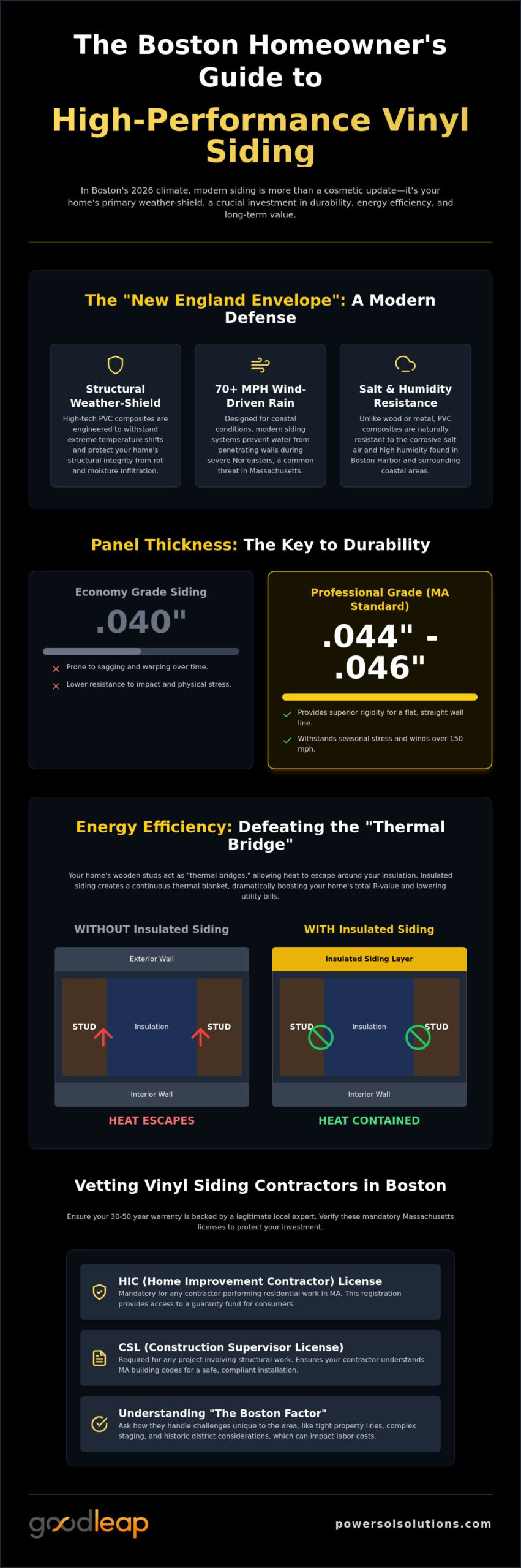
Modern Vinyl siding has undergone a technical revolution. It’s no longer just a plastic panel; it’s a high-tech PVC composite engineered for maximum thermal resistance. For homeowners working with vinyl siding contractors Boston residents trust, the goal is creating a “New England Envelope.” This structural barrier is designed to withstand 70+ mph wind-driven rain and the rapid freeze-thaw cycles that characterize our winters.
In neighborhoods adjacent to historic districts like the South End or Dorchester, we’re seeing a massive shift. Homeowners are moving away from traditional wood because they want the aesthetic of milled lumber without the exhausting maintenance cycle. Today’s premium panels mimic the deep grain of cedar shake and the crisp lines of traditional clapboard so closely that it’s nearly impossible to tell the difference from the curb. You get the pride of a historic look with the durability of modern materials.
Battling the New England Climate: Salt, Snow, and Humidity
Living near the coast in Quincy or Boston Harbor presents unique challenges. Salt air is incredibly corrosive to traditional materials, but modern PVC composites are naturally resistant to salt spray and high humidity. A precision installation also acts as a vital defense against ice damming. By integrating proper moisture barriers and ensuring the system can “breathe,” we prevent the moisture infiltration that often leads to structural rot in older Massachusetts homes. It’s about protecting the skeleton of your house from the relentless Atlantic moisture. Homeowners who want a fully fortified exterior should also consider how expert roof repair in Boston works in tandem with new siding to prevent water infiltration from every angle during harsh Nor’easters.
Energy Efficiency and the ‘Thermal Bridge’ Effect
Think of your siding as a high-performance blanket wrapped around your home’s wooden studs. Standard insulation sits between the studs, but the studs themselves act as “thermal bridges” that allow heat to escape directly through the walls. Thermal bridging occurs when heat escapes through the solid wooden studs of your home, bypassing the insulation between them and creating a significant drain on your energy efficiency. In classic Boston triple-deckers, this effect is a primary driver of high heating costs. By partnering with expert vinyl siding contractors Boston homeowners can install contoured, foam-backed siding to break this bridge. This upgrade significantly boosts your home’s total R-value, leading to noticeable relief on your monthly National Grid or Eversource bills.
Understanding Siding Grades: From Standard to Premium Insulated
Choosing the right material involves more than picking a color from a swatch book. The durability of your exterior depends heavily on panel thickness. While economy-grade siding often measures a flimsy .040 inches, the gold standard for long-term performance in Massachusetts is .044 to .046 inches. These professional-grade panels provide the rigidity needed to prevent sagging over time and offer superior resistance to the physical stress of our changing seasons. High-quality vinyl siding contractors Boston homeowners trust will always prioritize these thicker profiles to ensure a flat, straight wall line that lasts for decades.
Beyond thickness, you must consider wind load ratings. In exposed inland areas like Stoughton or Randolph, wind speeds during a nor’easter can put immense pressure on your home’s exterior. Premium siding systems feature double-nail hems that lock the panels securely to the wall, often rated to withstand winds exceeding 150 mph. Modern manufacturing also utilizes advanced capstocks. These high-performance outer layers are infused with UV inhibitors that protect against the sun’s rays, ensuring your home’s color remains vibrant without the chalking or fading common in older installations.
The Case for Insulated Siding in Massachusetts
Traditional hollow-back siding leaves a gap between the vinyl and your home. In contrast, contoured foam-backed siding fills that void completely. This solid core significantly improves impact resistance, protecting your home from hail or stray branches during summer storms. It also acts as a sound barrier, which is a major benefit for those living in high-traffic urban pockets of Boston. For a deeper look at the long-term savings, explore our Professional Insulated Siding Installation guide to see how this investment pays off.
Profiles and Textures: Finding Your Home’s Style
The profile you choose defines your home’s architectural character. Clapboard remains the quintessential choice for a “Boston Colonial” look, offering clean, horizontal lines. If you prefer a more pronounced shadow line, Dutch Lap provides a decorative groove that adds depth and traditional charm. For those seeking a contemporary edge, vertical Board and Batten siding serves as a striking accent on gables or entryways. Creating a cohesive look often involves matching these textures with durable roofing solutions to ensure your entire exterior works in harmony.
Selecting the right grade is the first step toward a worry-free home. By consulting with experienced vinyl siding contractors Boston residents can determine if premium insulated panels are the best fit for their specific micro-climate. If you’re unsure which thickness or profile fits your specific neighborhood, our team at Powersol Solutions is here to help you navigate these technical choices with confidence.
The Cost of Siding Installation in Greater Boston (2026)
Understanding the financial commitment of new siding requires looking beyond the price per square foot. In Massachusetts, the “Boston Factor” significantly influences the final investment. Narrow property lines in neighborhoods like South Boston or Somerville often require specialized scaffolding and intricate staging to ensure safety and compliance with local ordinances. These logistical challenges, combined with 2026 labor rates and supply chain shifts, mean that your choice of vinyl siding contractors Boston should be based on their ability to manage complex urban job sites efficiently.
The installation method also dictates the long-term cost. While a “lay-over” installation, which involves placing new vinyl over old wood, might seem budget-friendly, it often traps moisture and hides structural decay. A full “tear-off” is the professional standard. This process involves removing all old materials to inspect the underlying sheathing and install a fresh moisture barrier. It’s the only way to guarantee the integrity of your home’s exterior envelope. Additionally, remember to account for trim, soffits, and fascia. These components are essential for protecting your roofline and providing a polished, maintenance-free finish that lasts for decades.
Investment vs. Expense: Calculating Long-Term ROI
View your new siding as a capital improvement rather than a simple repair. Traditional wood siding requires professional painting every five to seven years, a recurring cost that disappears entirely with vinyl. According to the “Remodeling Magazine” Cost vs. Value report, siding replacement remains one of the highest-returning home improvements for resale value. When you factor in the energy savings from insulated panels, which can pay for themselves through reduced utility bills over 10 to 15 years, the long-term financial benefits become clear.
Financing and Incentives for MA Homeowners
Many Massachusetts residents leverage energy-efficiency programs to offset their project costs. You should explore Mass Save rebates or specialized heat-loan programs that often apply to exterior upgrades that improve your home’s thermal envelope. To protect your investment, always insist on a transparent, fixed-price quote. The cheapest estimate often stems from a contractor who cuts corners on permits or insurance, leading to expensive repairs or legal headaches later. A trusted partner will provide a comprehensive breakdown that eliminates mid-project surprises and ensures the job is done right the first time.
How to Vet Vinyl Siding Contractors in Boston
Selecting a partner to open up your home’s exterior is a decision rooted in trust and technical verification. In Massachusetts, you must confirm two specific credentials before any work begins: the Home Improvement Contractor (HIC) registration and the Construction Supervisor License (CSL). These aren’t just bureaucratic suggestions. They are legal requirements that provide you with access to the state’s Guaranty Fund and ensure the person overseeing your project understands the rigorous Massachusetts building codes. When you interview vinyl siding contractors Boston homeowners should also look for VSI (Vinyl Siding Institute) Certified Installer status. This certification proves the crew understands the specific expansion and contraction properties of PVC, which is vital for preventing warped panels during our extreme temperature swings.
Examine a contractor’s local portfolio with a focus on precision. Ask to see completed projects in towns like Brockton or Holbrook to see how they handle the architectural nuances of New England homes. Beyond aesthetics, insurance is your primary safety net. Demand current certificates for both General Liability and Workers’ Compensation. If a worker is injured on your property without coverage, you could be held liable for the costs. A professional partner will provide these documents proactively, demonstrating a commitment to protecting both their crew and your household.
Critical Questions to Ask Before Signing
Before you commit, clarify who will be on-site daily. You need a dedicated supervisor who can answer questions in real-time and ensure the project stays on schedule. Ask specifically how the team handles unforeseen rot or structural damage discovered after the old siding is removed. A quality contractor won’t just cover up the problem; they will document the damage and provide a clear plan for the repair. For a comprehensive vetting template, you can adapt these 45 Essential Questions to Ask a Roofing Contractor to ensure no detail is overlooked during your siding project.
Navigating Boston Permits and Logistics
Managing the logistics of an urban job site requires a specialist’s touch. Your contractor should handle all municipal permits in cities like Quincy or Boston, ensuring the project complies with local zoning and historic commission rules. In dense residential zones, neighbor relations are just as important as the installation itself. We prioritize clear communication regarding dumpster placement and work hours to minimize disruption. Finally, ensure your team has a strategy for the unpredictable New England weather. A professional crew knows how to secure your home’s envelope daily, protecting it from sudden rain or snow during the transition. Pairing your siding upgrade with timely roof repair in Boston ensures your entire exterior is fortified before the next major storm season arrives.
If you’re ready to partner with a team that prioritizes precision and protects your home’s integrity, contact Powersol Solutions for a detailed exterior assessment.
Powersol Solutions: Your Trusted Boston Siding Partner
With over a decade of industry experience in Massachusetts, Powersol Solutions has built a reputation for excellence that national franchises simply can’t match. We aren’t just one of many vinyl siding contractors Boston residents can call; we’re a local partner committed to the long-term health of your home. Our team understands that a siding project is a major investment in your family’s security. We focus on precision installation and meticulous craftsmanship to ensure that every panel, trim piece, and moisture barrier works together to protect your home’s structural integrity. This dedication to quality ensures your exterior looks like real wood while remaining entirely maintenance-free.
The “Powersol Partnership” is designed to take the burden of coordination off your shoulders. We believe in clear, honest communication from the initial fixed-price quote to the final project walkthrough. You won’t face high-pressure sales tactics here. Instead, you’ll work with seasoned experts who treat your property with the same care they would their own. We handle the technical details, municipal permits, and site logistics so you can focus on the pride of homeownership. By choosing a full-service specialist, you ensure that every aspect of your home’s exterior is handled with an obsessive attention to detail.
Comprehensive Protection: Siding, Roofing, and Windows
We utilize a “Total Exterior” approach to ensure your home’s envelope is completely sealed against the elements. Replacing siding and windows together allows for a perfect weather seal at the critical junction where the wall meets the window frame. By consulting with Finding Professional Window Installers in MA, you can ensure your energy efficiency upgrades are fully integrated for maximum utility savings. Our Boston roofing specialists also coordinate directly with the siding crew to prevent water infiltration at the roofline. This level of synchronization protects your home from the top down, providing a unified defense against the New England climate.
Ready to Transform Your Home?
Choosing the right vinyl siding contractors Boston has to offer means looking for a company that values your peace of mind as much as your curb appeal. We invite you to schedule a professional exterior assessment to identify the best material grades and insulation values for your specific micro-climate. Our goal is to provide a durable, expert installation that stands the test of time and protects your home’s value for the next 30 to 50 years. Request your professional siding estimate from Powersol Solutions today.
Invest in Your Home’s Long-Term Protection
Your home’s exterior is its first line of defense against the unpredictable Massachusetts climate. By prioritizing high-grade materials and a complete “New England Envelope,” you’re doing more than just improving curb appeal; you’re securing a maintenance-free future and lower utility bills. Technical precision during the installation phase is the difference between a siding system that fails in a decade and one that lasts a lifetime. Choosing the right vinyl siding contractors Boston homeowners rely on requires verifying local licenses and demanding a proven track record of excellence.
At Powersol Solutions, we bring over 10 years of Massachusetts expertise to every project. We are fully licensed and insured, holding both HIC and CSL credentials to give you total peace of mind. Whether you need a full siding replacement or integrated exterior solutions including roofing and windows, our team is ready to act as your trusted partner. We look forward to helping you build a home that is as efficient as it is beautiful and durable.
Secure Your Home with a Professional Siding Consultation
Frequently Asked Questions
How much does vinyl siding installation cost in Boston in 2026?
Siding costs in the Greater Boston area depend on the total square footage of your home and the specific panel grade you choose. While market rates reflect the high cost of skilled labor in Massachusetts, investing in premium insulated panels often yields a higher return through energy savings. A professional quote should always include the cost of a full tear-off, moisture barriers, and finishing trim to ensure your project stays within budget.
Is vinyl siding better than fiber cement for New England weather?
Vinyl siding offers a distinct advantage in coastal New England due to its natural resistance to salt air and moisture. Unlike fiber cement, which can absorb water if not properly sealed, modern PVC composites won’t rot or delaminate. This makes it an ideal choice for the “New England Envelope” strategy, providing a maintenance-free barrier that handles our 70+ mph wind-driven rain without requiring frequent repainting. For a detailed side-by-side analysis of both materials, our vinyl vs fiber cement siding MA comparison guide breaks down the durability, cost, and thermal performance of each option to help you make the right choice for your home.
How long does a typical siding replacement take for a standard Boston home?
A standard siding replacement for a 2,000 square foot home typically takes between 7 and 14 business days. This timeframe includes the removal of old materials, structural inspections, and the precision installation of the new system. Complex urban sites in neighborhoods like South Boston may require additional time for staging and scaffolding, but seasoned vinyl siding contractors Boston residents trust will provide a clear, daily schedule to minimize disruption.
Do I need a permit to replace my siding in Massachusetts?
Yes, you generally need a “Short-Form” building permit for siding replacement in Massachusetts. If the project involves structural changes or moving electrical wiring, additional permits are required. Your contractor must hold a valid Home Improvement Contractor (HIC) registration and a Construction Supervisor License (CSL) to pull these permits legally, ensuring the work complies with the latest 2021 MA Stretch Code for energy efficiency.
Can vinyl siding be installed over my existing wood siding?
While a “lay-over” installation is technically possible, professional installers strongly recommend a full tear-off. Installing new panels over existing wood can trap moisture, leading to hidden rot and mold within your walls. Removing the old siding allows us to inspect the sheathing, repair any structural damage, and install a modern house wrap. This methodical approach ensures your home’s integrity and maximizes the lifespan of your new siding.
What is the best time of year to schedule siding installation in MA?
Spring and Fall are the most popular seasons for installation due to the mild temperatures, but professional crews can work year-round. Modern vinyl is engineered to be installed in colder weather, provided the installers use the correct spacing for expansion and contraction. Scheduling during the “off-peak” winter months can sometimes lead to faster project start dates, as long as the weather remains safe for the crew.
Does new siding actually lower my energy bills?
New siding significantly lowers your utility bills by improving your home’s thermal envelope. Standard vinyl provides a durable shield, but insulated siding adds a layer of foam that breaks the “thermal bridge” caused by wooden studs. This prevents heat from escaping directly through the walls, helping you maintain a consistent indoor temperature and reducing the workload on your HVAC system during extreme Boston winters and summers.
What kind of warranty should I expect from a professional siding contractor?
You should expect a comprehensive warranty package that includes both material and labor coverage. Most premium manufacturers provide a 30 to 50 year warranty on the panels themselves, covering defects like fading or cracking. Additionally, reputable vinyl siding contractors Boston homeowners hire will offer a separate workmanship warranty. This local guarantee ensures that the installation itself is sound and that the company stands behind their craftsmanship for years to come.