
Is your home’s exterior a true shield against the next Nor’easter, or is it just a ticking clock of maintenance and rising energy bills? For many in the Commonwealth, the choice between materials often feels like a gamble between immediate savings and long term security. You likely already know that the Massachusetts climate is uniquely punishing. Between the humid salt air on the coast and the brutal freeze-thaw cycles inland, your siding must perform as a structural defense system rather than just a cosmetic layer.
We understand that you want a “one-and-done” solution that boosts curb appeal while slashing utility costs. This 2026 guide provides a definitive look at vinyl vs fiber cement siding MA to help you make an investment that protects your family for decades. We will compare the durability, cost, and thermal performance of both materials so you can choose the right fit for your property’s specific needs. You’ll discover how these options impact your home’s resale value and which one offers the best protection against the unpredictable New England weather.
Key Takeaways
- Resist the New England climate. Discover how fiber cement’s composition prevents cracking during freeze-thaw cycles, ensuring your home remains secure through harsh winters.
- Maximize your investment. Learn why fiber cement projects in the New England market currently offer a significantly higher return on investment compared to traditional vinyl.
- Ensure structural integrity. Understand the critical importance of a complete tear-off and professional moisture barrier installation to prevent hidden rot behind your new siding.
- Make an informed choice. Use our direct comparison of vinyl vs fiber cement siding MA to balance upfront costs with long-term maintenance cycles and curb appeal.
- Prioritize safety and precision. Gain insight into the specialized equipment and techniques required to handle the weight and silica dust of modern composite materials.
The Battle of Materials: Fiber Cement vs. Vinyl Siding for MA Homes
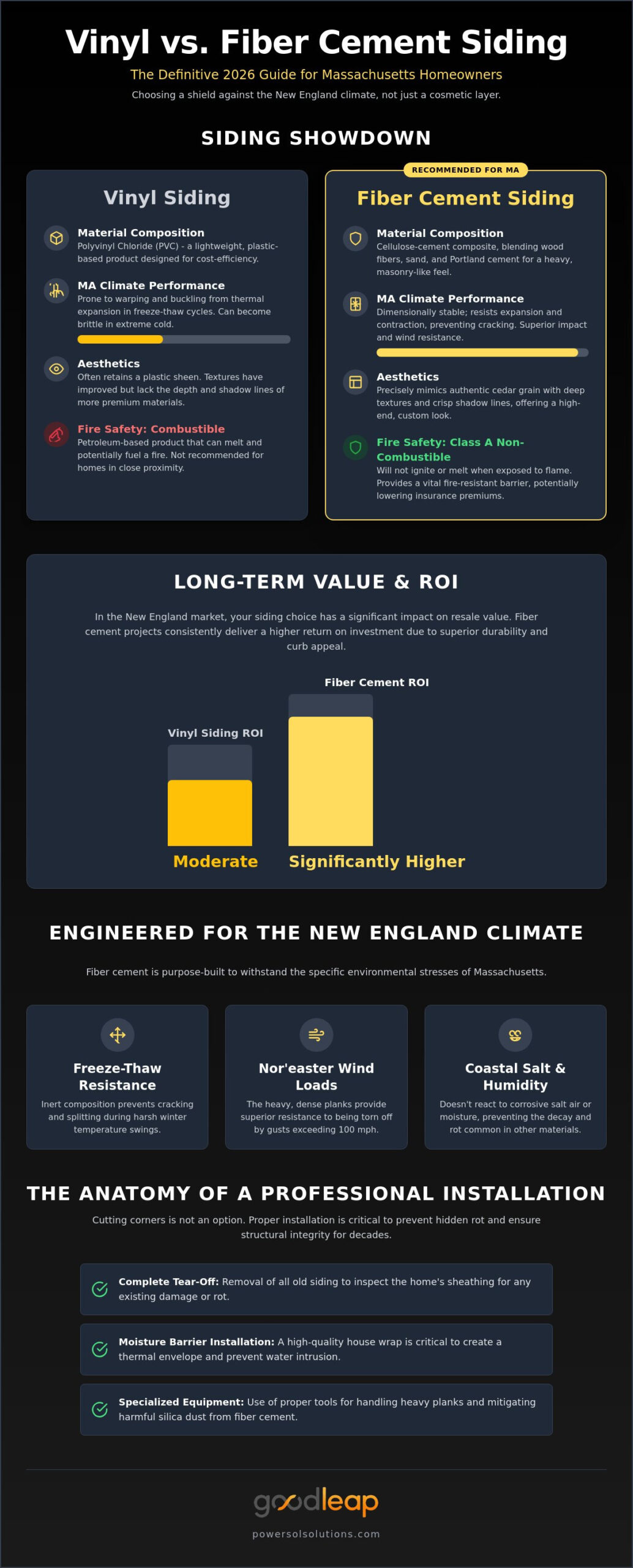
Choosing the right exterior cladding often comes down to a fundamental choice between two distinct engineering philosophies. On one side, we have traditional polyvinyl chloride, commonly known as vinyl. If you are researching What is Vinyl Siding?, you’ll find it’s a lightweight, plastic-based product designed for cost-efficiency and ease of care. On the other side stands fiber cement, a sophisticated cellulose-cement composite that blends wood fibers with sand and Portland cement. This combination creates a heavy, dense plank that provides a masonry-like feel to your residential frame, making the home feel more substantial and secure against the elements.
Modern fiber cement has revolutionized home design by mimicking authentic cedar grain with incredible precision. While vinyl has made strides in texture, it often retains a plastic sheen that can look artificial under the bright New England sun. Fiber cement planks are significantly thicker, allowing for deeper grain textures and crisp shadow lines that are virtually indistinguishable from real wood. This aesthetic shift allows homeowners to achieve a high-end, custom look without the constant rot and pest concerns associated with natural timber.
By 2026, fiber cement has established itself as the gold standard for residential durability and fire resistance, serving as a primary defense for homeowners who prioritize long term safety and structural integrity.
Core Material Differences
Chemical stability is a major factor when evaluating vinyl vs fiber cement siding MA. Vinyl is highly sensitive to temperature; it expands and contracts significantly as Massachusetts swings from summer humidity to winter deep-freezes. This thermal movement can lead to warping or buckling if the installation isn’t handled with extreme care. Fiber cement is dimensionally stable. It resists this movement, ensuring your seams stay tight. Additionally, the sheer thickness of fiber cement provides superior impact resistance against hail or wind-blown debris during a Nor’easter. While vinyl uses through-body color, fiber cement utilizes factory-baked finishes that offer a richness and depth of color that resists fading far longer than standard plastics.
Fire Safety and Insurance
Safety is where these materials diverge most sharply. Fiber cement carries a Class A fire rating because it is non-combustible; it will not melt or ignite when exposed to direct flame. Vinyl, being a petroleum-based product, can melt and even fuel a fire if a nearby heat source gets too close. For homeowners in densely populated areas like Boston or Quincy, where houses are often built in close proximity, this fire-resistant barrier is vital. Beyond the immediate peace of mind, many insurance providers offer premium reductions for homes clad in non-combustible materials. It is a wise investment that protects your family while potentially lowering your annual homeownership costs.
Performance in the New England Climate: Why Your Zip Code Matters
Massachusetts weather is notoriously unforgiving. When evaluating vinyl vs fiber cement siding MA, homeowners must consider that their exterior isn’t just a facade; it is a thermal envelope. In regions like Quincy and the South Shore, the air is thick with corrosive salt. Inland areas like Holbrook and Brockton experience violent freeze-thaw cycles that can shatter brittle materials. Fiber cement is engineered to withstand these specific New England stresses without the cracking or brittleness often seen in standard plastics. It remains inert, meaning it doesn’t react to the moisture or salt that typically accelerates the decay of wood or lower-grade vinyl.
Wind load performance is another critical factor for coastal residences. During a Nor’easter, gusts can easily exceed 100 mph, creating immense pressure on your home’s siding. Because fiber cement is a heavy, dense composite, it offers a much higher resistance to being torn from the fasteners compared to lightweight alternatives. This weight provides a structural “heft” that keeps the planks securely pinned to the wall, even when the wind is howling off the Atlantic. This durability ensures your home remains a safe sanctuary, regardless of the season’s intensity.
Humidity and rot are the silent enemies of New England springs. The damp, cool air can trap moisture behind poorly installed panels, leading to mold growth and structural rot. Fiber cement’s composition makes it naturally resistant to these threats. It doesn’t provide a food source for pests and won’t soften when exposed to prolonged rain. You can start protecting your home today by connecting with a local specialist who understands these regional challenges.
Moisture Management and Rainscreens
A professional installation focuses on what happens behind the planks. We prioritize high-quality house wraps that allow the structure to breathe while keeping liquid water out. This prevents the “warping” common in older vinyl installations where trapped heat and moisture distort the material. For a truly watertight seal, we recommend integrating your siding with durable roofing solutions. This systematic approach ensures that water is shed away from the foundation and roofline transitions, protecting your largest investment from the top down.
Thermal Stability and Efficiency
Density directly impacts your heating bill. Massachusetts homes face 100-degree temperature swings throughout the year, which can cause significant thermal bridging. Scientific studies on the Performance and Durability of Siding show that material formulation is key to long-term efficiency. By pairing your choice with insulated siding installation, you create a continuous barrier of protection. This setup reduces energy loss, keeping your Bridgewater or Brockton home warmer in the winter and cooler in the summer without overtaxing your HVAC system.
Professional Installation vs. DIY: The Risks of Cutting Corners
While the debate over vinyl vs fiber cement siding MA often focuses on aesthetics, the physical reality of the installation is where many homeowners run into trouble. Fiber cement planks are incredibly heavy, often weighing up to 80lbs per piece. This isn’t a solo project; it requires a coordinated professional crew to ensure each board is handled without snapping or causing injury. Beyond the weight, the cutting process is highly specialized. Unlike vinyl, which can be trimmed with simple snips, fiber cement requires polycrystalline diamond-tipped blades. These tools are designed to handle the density of the material without burning out or creating jagged, unprofessional edges.
Safety is another area where DIY efforts often fall short. Cutting fiber cement releases silica dust, a known health hazard that requires OSHA-mandated cutting techniques and high-efficiency particulate air (HEPA) filtration. Professional teams use specialized dust-collection saws or water-fed cutters to keep the job site safe for your family and the neighborhood. When you evaluate the total Fiber Cement Siding Cost, you aren’t just paying for the material; you are investing in the specialized equipment and safety protocols that protect your property and health. DIY siding mistakes often lead to hidden rot that costs thousands more than the initial labor savings. Compounding these risks, a compromised roof above failing siding can accelerate moisture intrusion dramatically, making it equally important to address any vulnerabilities with professional roof repair in Boston before or alongside your siding project.
Warranty Protection and Manufacturer Standards
Manufacturer standards are incredibly strict for composite materials. Most fiber cement warranties are only valid if the product is installed by a certified professional who follows specific fastening patterns. There is a common “nailing zone” myth where homeowners believe any part of the top flange is acceptable, but precision depth and placement determine the life of your siding. Over-caulking expansion joints is another frequent error. These joints must be allowed to move naturally, and clogging them with sealant can trap moisture and cause the boards to buckle over time.
Structural Integration
Your siding is only as good as the flashing beneath it. Proper integration at windows and complex roof lines is essential to prevent water intrusion. We often recommend consulting with boston roofing specialists for these transitions, as the point where your siding meets your shingles is the most vulnerable spot on your home. Choosing between vinyl vs fiber cement siding MA also means choosing the level of accountability you want. A professional installation comes with a 10-year workmanship guarantee, providing a layer of security that a weekend DIY project simply cannot match.
The Anatomy of a Professional Siding Installation
A successful siding project is defined by the quality of the work hidden beneath the surface. When deciding between vinyl vs fiber cement siding MA, the material choice is only half the battle; the sequence of execution determines whether your home remains a dry sanctuary or becomes a victim of trapped moisture. We follow a methodical, step-by-step process designed to ensure your exterior performs as a unified defense system. This logical progression prevents common failures and ensures every manufacturer specification is met with obsessive attention to detail.
- Step 1: Complete Tear-Off and Substrate Inspection. We never install new materials over old, failing siding. Removing the existing layers is the only way to inspect the sheathing for structural integrity and hidden rot.
- Step 2: Integrated Moisture Barrier. We install a high-performance weather-resistive barrier, carefully integrated with flashing at all penetrations to prevent liquid water from reaching the wood frame.
- Step 3: Precision Layout. Using starter strips and laser-leveling, we establish perfectly level courses. This ensures the visual lines of your home remain crisp and professional from the foundation to the gables.
- Step 4: Blind-Nailing and Fastening. For fiber cement, we utilize blind-nailing techniques where fasteners are hidden by the overlapping plank. This creates a seamless look while securing the boards against 100 mph wind gusts.
- Step 5: Final Sealing and Trim Integration. The project concludes with specialized sealant application at joints and the integration of decorative trim, providing the high-end curb appeal you expect.
Preparing the Sheathing
The health of your home’s “skeleton” is our first priority. After the tear-off, we identify and repair any compromised sheathing to ensure a solid nail-base. This step is vital for high-wind resistance and long-term stability. During this phase, we also manage the critical transitions between your new cladding and replacement windows Boston. Ensuring these gaps are properly flashed and sealed prevents the leaks that often plague less meticulous installations. If you’re ready to secure your home’s envelope, schedule a comprehensive substrate inspection with our team today.
Finishing Touches and Quality Control
Precision continues through the very last day of the project. We use advanced caulking techniques specifically designed for the expansion and contraction rates of your chosen material. We maintain precise expansion gaps at the trim boards to prevent buckling during the intense temperature swings common in Massachusetts. Before we consider the job done, we conduct a final walkthrough to verify that every plank and fastener meets our rigorous standards for craftsmanship. This commitment to excellence ensures your investment remains beautiful and functional for decades.
Long-Term Value: ROI and Curb Appeal in the 2026 MA Market
Investing in your home’s exterior is a decision that impacts your financial portfolio as much as your daily comfort. When weighing vinyl vs fiber cement siding MA, the long term return on investment (ROI) often becomes the deciding factor. In the New England market, fiber cement siding projects currently see an average ROI of 144%, significantly outperforming vinyl’s 97% return. This discrepancy exists because fiber cement is viewed as a premium, permanent upgrade. In the competitive Massachusetts real estate market, seeing high-grade composites on a listing acts as a signal of quality to potential buyers, often accelerating the sale and justifying a higher asking price.
Maintenance cycles also play a vital role in the total value proposition. While vinyl is often marketed as “maintenance-free,” it is susceptible to permanent fading and brittleness over time. Fiber cement, conversely, features factory-baked finishes that typically offer a 15-year paint life. This allows you to refresh the look of your home without the massive expense of a full replacement. At Powersol Solutions, we provide the local expertise necessary to navigate these choices. From the historic neighborhoods of Bridgewater to the coastal streets of Boston, we ensure your siding is calibrated for both maximum curb appeal and regional durability.
Financial Wisdom for Homeowners
Evaluating the “Total Cost of Ownership” requires looking beyond the initial installation. Over a 30-year period, the durability of fiber cement often makes it the more economical choice due to its resistance to storm damage and rot. You can further enhance these savings by addressing other parts of the building envelope. For instance, considering double pane window replacement alongside your siding project creates a comprehensive thermal barrier. This holistic approach reduces energy loss and lowers utility bills. Choosing vinyl vs fiber cement siding MA also means considering local regulations. Our deep understanding of Brockton and Randolph building codes ensures your project is compliant and efficient from day one, preventing costly delays.
Next Steps for Your Home Transformation
Transforming your home into a maintenance-free, storm-resistant sanctuary starts with a clear plan. Many homeowners also find that pairing a siding upgrade with a window replacement for insulation project delivers the most dramatic reduction in energy loss, sealing the entire building envelope against New England’s brutal temperature swings. We invite you to schedule a comprehensive exterior evaluation where we assess your current substrate and discuss your aesthetic goals. During a professional consultation with Powersol Solutions, you’ll receive a detailed roadmap for your project, from material selection to the final walkthrough. We take the burden of coordination off your shoulders, acting as your visionary partner in protecting your home’s integrity. Let’s work together to build a legacy of efficiency and beauty for your property.
Secure Your Home’s Future Today
Choosing between vinyl vs fiber cement siding MA is one of the most significant decisions you’ll make for your property’s long-term health. The right material acts as a structural shield against the unpredictable Massachusetts climate, while a professional installation ensures your warranty and energy efficiency remain intact. Whether you prioritize the high return on investment of fiber cement or the cost-effective nature of vinyl, your goal is a home that stands strong against every Nor’easter.
At Powersol Solutions, we bring over 10 years of New England exterior expertise to every project. Our specialized crews focus on meticulous precision, especially during critical siding-to-roof transitions, to guarantee a watertight seal. We take pride in supporting homeowners across Boston, Quincy, and the South Shore with reliable, local service. Protect your home with a professional fiber cement siding consultation from Powersol Solutions today. We’re ready to help you build a more beautiful, durable, and efficient exterior that you’ll be proud of for decades to come.
Frequently Asked Questions
How much more expensive is fiber cement siding than vinyl in Massachusetts?
Fiber cement generally carries a higher upfront cost than vinyl due to the material’s density and the labor intensity required for installation. While vinyl is lightweight and snaps together quickly, fiber cement involves heavy 80lb planks and specialized diamond-tipped cutting tools. Most homeowners find that the higher initial investment is offset by the material’s superior lifespan and the significantly higher resale value it adds to a New England property.
Can fiber cement siding be installed during a Massachusetts winter?
Yes, professional crews can install fiber cement during the winter months, provided weather conditions allow for safe outdoor work. Unlike vinyl, which can become brittle and crack when cut in freezing temperatures, fiber cement remains dimensionally stable in the cold. This makes it an excellent option for homeowners who need to address failing exteriors before the spring thaw brings heavy rains and potential moisture damage.
Do I ever need to paint my fiber cement siding after installation?
You’ll eventually need to paint fiber cement siding, though modern factory-baked finishes are designed to last approximately 15 years. This is a primary consideration when comparing vinyl vs fiber cement siding MA; while vinyl’s color is through-body and never needs paint, it will eventually fade from sun exposure and cannot be refreshed. Fiber cement allows you to update your home’s color without replacing the entire siding system.
How long does a professional siding installation typically take?
A typical residential siding replacement in Massachusetts takes between one and two weeks to complete from start to finish. This timeline includes the essential complete tear-off of old materials, substrate inspection, and the meticulous installation of moisture barriers and flashing. Larger homes or those with complex architectural details and custom trim work may require additional time to ensure every joint is perfectly sealed.
Does fiber cement siding provide better insulation than vinyl?
Fiber cement is much denser than standard vinyl, but neither material provides a high R-value on its own. The density of fiber cement does help reduce noise transmission and provides a more substantial thermal mass. To truly lower your utility bills, we recommend pairing your siding choice with a window replacement for insulation upgrade and a professional insulated house wrap or rigid foam backing to create a continuous thermal bridge.
Is fiber cement siding environmentally friendly or sustainable?
Fiber cement is considered a sustainable building material because it is composed of natural elements like wood pulp, sand, and Portland cement. It is a non-toxic product that doesn’t off-gas like some plastic-based materials. Because it lasts decades longer than cheaper alternatives, it reduces the frequency of replacements and the amount of construction debris that ends up in local landfills over the life of the home.
Will fiber cement siding increase my Massachusetts home’s resale value?
Yes, installing fiber cement is consistently ranked as one of the highest-returning home improvement projects in the New England market. Local buyers and real estate professionals recognize the material as a premium upgrade that offers superior protection against coastal salt air and harsh winters. Choosing this material often results in a faster sale and a higher closing price compared to homes with standard vinyl exteriors.
What is the best way to clean and maintain fiber cement siding?
The best way to maintain your siding is through an annual low-pressure wash using a garden hose and a soft-bristle brush. You should avoid high-pressure power washing, as the intense force can damage the factory finish or drive moisture into the wall cavity. It’s also wise to perform a yearly inspection of the caulked joints around windows and doors to ensure the seal remains watertight and flexible.