
What if the most expensive part of your window replacement isn’t the glass itself, but the heat you’re losing every minute through an inferior seal? As of January 1, 2026, the federal tax credits many homeowners relied on have officially expired, making a precision energy efficient window installation more critical than ever for your bottom line. We understand the frustration of watching utility bills climb while dealing with stubborn condensation and confusing technical ratings like U-factors or SHGC.
You deserve a home that acts as a fortress against the unpredictable New England climate. We’ll show you how to navigate the 2026 landscape by maximizing the $75 Mass Save rebates and utilizing 0% financing options to protect your budget. This guide covers everything from the latest ENERGY STAR Version 7.0 standards to the specific craftsmanship that eliminates drafts. You’ll learn how to transform your living space into a quieter, more comfortable sanctuary while building long-term property value and slashing monthly costs.
Key Takeaways
- Understand how a holistic energy efficient window installation seals your home’s envelope against the extreme temperature swings of the New England climate.
- Identify the three essential pillars of window technology, including frame stability and gas fills, that maintain airtight performance for decades.
- Master efficiency metrics like the U-Factor to ensure your new windows meet the strict 0.27 requirement for 2026 Massachusetts rebates.
- Learn why precision craftsmanship in leveling and squaring is the only way to prevent a high-end window from performing like a budget alternative.
- Explore how to leverage state-level incentives like the $75 Mass Save rebate and 0% HEAT Loan to fund your home modernization project.
Understanding Energy Efficient Window Installation in the New England Climate
True energy efficient window installation is far more than just swapping out old glass. It’s a comprehensive strategy designed to seal your home’s envelope against the relentless elements of the Northeast. In Massachusetts, our homes face brutal humidity in July and sub-zero wind chills in January. Standard windows often fail because they weren’t engineered for these 100-degree temperature swings. When a frame expands and contracts excessively, the seal eventually breaks, leading to energy loss that costs you money every single month.
Local challenges like ice damming can also compromise poorly installed windows. When heat leaks through the top of a window frame, it melts snow on the roof above, which then refreezes at the eaves. This creates a cycle of water damage that can rot the structural headers holding your window in place. Our primary goal is total thermal protection. We want to ensure your home remains a stable, protected environment regardless of the weather patterns shifting outside your door.
By 2026, home buyers have become increasingly sophisticated about efficiency and sustainability. A property with documented high-performance window upgrades commands a higher resale value because it represents a “turnkey” investment in lower operating costs. Buyers recognize that the work has already been done to protect the home’s integrity and comfort for the next generation.
The Real Cost of Drafty Windows
Drafty windows do more than just let in a chill; they provide clear signals that your home is losing money. You might notice “weeping” glass, where condensation builds up between panes, or persistent cold zones that make certain rooms unusable in winter. These symptoms indicate that your thermal barrier has failed. This constant air leakage forces your HVAC system to cycle indefinitely to maintain a set temperature. This extra strain significantly shortens the lifespan of expensive furnaces and air conditioners. Beyond the utility bills, inefficient windows allow noise pollution to invade your space, while modern Insulated glazing improves home acoustics by dampening street sounds.
Defining ENERGY STAR Standards for 2026
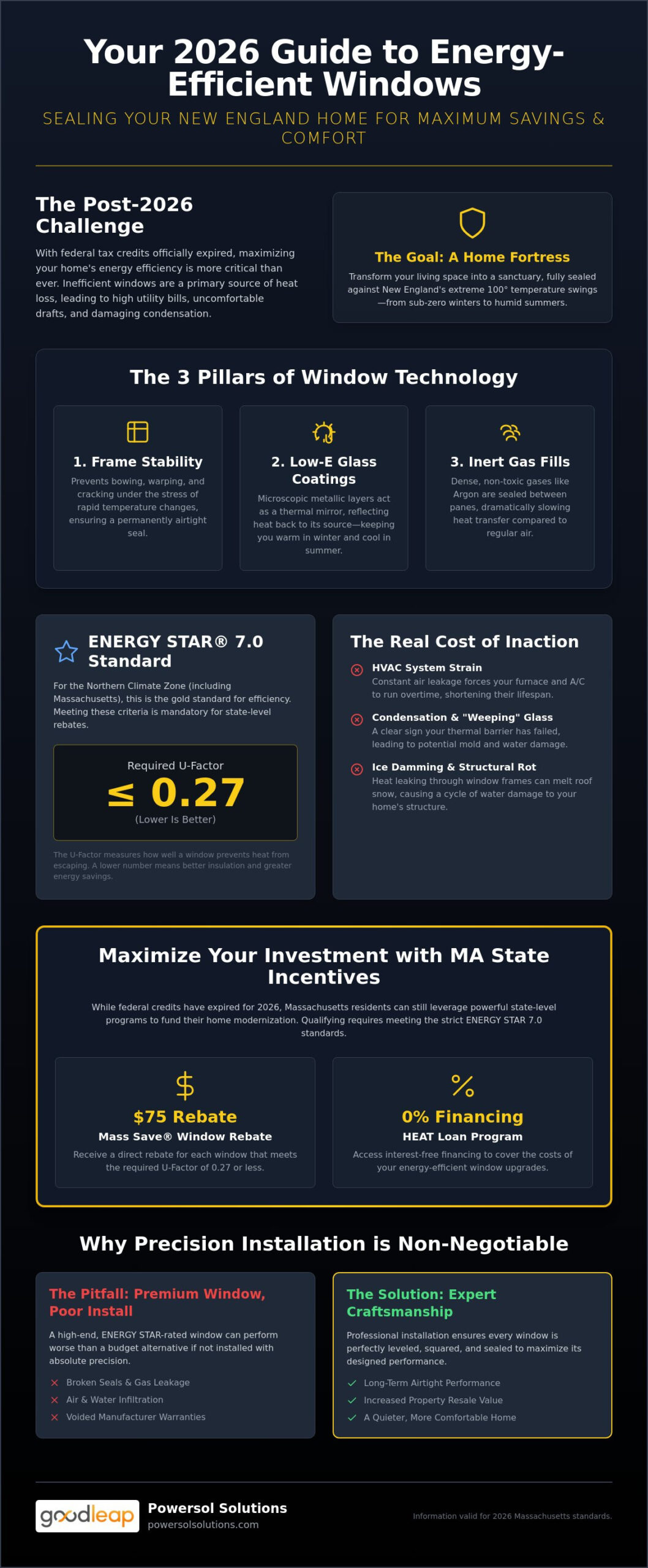
The ENERGY STAR label is the industry’s gold standard for identifying products that reduce greenhouse gas emissions and maximize energy savings. For the Northern Climate Zone, which includes all of Massachusetts, the current Version 7.0 standard requires a U-Factor of 0.27 or lower to meet the “Most Efficient” designation. While federal tax credits under Section 25C have expired for 2026 installations, meeting these strict ENERGY STAR criteria remains the mandatory requirement for securing state-level incentives like the $75 Mass Save window rebate. Choosing a window that meets these 2026 standards ensures your energy efficient window installation provides the highest possible return on investment.
The Anatomy of a High-Performance Window: Glass, Frames, and Gas
A high-performance window is a precision-engineered system where every component serves a specific thermal purpose. It’s not simply a piece of glass sitting in a track; it’s a multi-layered barrier designed to defend your home’s interior climate. To achieve a successful energy efficient window installation, you must understand the three pillars of window technology: the frame material, the glass panes, and the insulating gas fills. When these elements are synchronized, they create a thermal shield that remains effective for decades.
Frame stability is perhaps the most overlooked aspect of long-term efficiency. In Massachusetts, frames must withstand the physical stress of rapid temperature drops. If a frame lacks structural integrity, it can bow or warp, which instantly snaps the airtight seal and allows energy to escape. Modern engineering has also revolutionized spacer technology. These small pieces keep glass panes at a precise distance from one another. While old metal spacers often conducted cold and caused edge-of-glass condensation, modern “warm-edge” spacers use non-conductive materials to eliminate those weeping edges and cold spots.
Low-E Glass Coatings and Argon Gas Fills
Modern glass is treated with Low-Emissivity (Low-E) coatings, which are microscopic, transparent metallic layers applied to the surface. These layers act like a thermal mirror, reflecting heat back to its source. In the winter, it keeps your furnace’s heat inside; in the summer, it bounces solar radiation away from your home. Between these panes, manufacturers inject dense, inert gases like Argon or Krypton. These gases are significantly heavier than air, which slows down the movement of heat through the window unit. Because of these advancements, double pane window replacement has become the baseline standard for any homeowner looking to meet 2026 efficiency goals in the Northeast.
Frame Materials: Beyond Basic Aesthetics
The material you choose for your frames dictates how well your windows will age. Vinyl frames remain a top choice for their excellent insulation properties and cost-effectiveness. High-quality vinyl contains chambers that trap air, providing an extra layer of thermal resistance. For those seeking maximum rigidity, composite frames offer a blend of wood fibers and polymer that resists “bowing” even during the most extreme New England cold snaps. This structural strength ensures the window remains squared and leveled, maintaining that critical airtight seal year after year. If you’re unsure which material fits your property’s specific needs, you can consult with our project experts to evaluate the best options for your home’s exposure and architectural style.
Evaluating Efficiency Metrics: U-Factor, SHGC, and VT
When you invest in an energy efficient window installation, you shouldn’t have to rely on a salesperson’s word for performance. The National Fenestration Rating Council (NFRC) serves as the industry’s independent watchdog, providing a standardized way to compare how windows actually perform. By looking for the NFRC label, you can verify technical claims and ensure the product meets the specific demands of our local climate. These metrics transform vague promises of “savings” into measurable data points you can trust.
The most critical number for any Massachusetts homeowner is the U-Factor. This metric measures how well a window prevents heat from escaping your home. In a region where heating bills dominate the winter budget, a low U-Factor is your primary defense. While the glass is important, the NFRC evaluates the entire unit, including the frame and spacers, to give you an accurate picture of the window’s total thermal resistance. Beyond heat retention, we also look at the Solar Heat Gain Coefficient (SHGC), which measures how much solar radiation enters your home. Finally, Visible Transmittance (VT) ensures that your high-performance coatings don’t turn your living room into a dark cave; modern engineering allows for maximum efficiency while still letting in abundant natural light.
Deciphering the NFRC Label
You’ll find the NFRC label as a temporary sticker on the glass of every new, certified window unit. It’s vital to remember these ratings represent the whole window’s performance, not just the center of the glass. For a successful energy efficient window installation in New England, use this cheat sheet for your target ratings:
- U-Factor: Look for 0.27 or lower to meet ENERGY STAR 7.0 “Most Efficient” standards.
- SHGC: Aim for a balanced rating between 0.20 and 0.40 depending on your home’s orientation.
- VT: A higher number (closer to 1) means more natural light for your interior spaces.
Choosing for the Massachusetts Northern Zone
In the Massachusetts Northern Zone, your strategy should vary based on where the window sits. For south-facing windows, a slightly higher SHGC can be beneficial, as it allows for “passive solar” heating during bright winter days. However, for windows that remain in the shade, prioritize the lowest possible U-Factor. While triple-pane units offer the ultimate in efficiency, they are significantly heavier and may require structural checks. Most local homeowners find that high-quality double-pane units with Argon fills provide the best balance of performance and value. To secure the $75 Mass Save rebate, ensure your selected windows meet the “Most Efficient” designation with that critical 0.27 U-Factor or lower.
Why Professional Installation is the Key to Real Energy Savings
A high-performance window is a significant investment in your home’s integrity, but its value is entirely dependent on the hands that install it. You could purchase the most advanced unit on the market, but a $2,000 window performs like a $200 bargain-bin alternative if the installation is flawed. Precision is the difference between a lifetime of utility savings and a decade of structural frustration. When we talk about energy efficient window installation, we aren’t just discussing the glass; we’re talking about the engineering of the entire opening.
Precision begins with leveling and squaring the frame within the rough opening. If a window is off by even a fraction of an inch, the sashes won’t seat properly against the weatherstripping. This creates microscopic gaps where New England’s winter winds can whistle through, rendering your high-tech glass useless. We use specialized low-expansion foam to fill the cavities around the frame. Unlike standard fiberglass insulation, which can hold moisture and settle over time, this foam expands to fill every void. This process effectively eliminates thermal bridging, which occurs when heat bypasses the window unit entirely through the surrounding wall cavity.
In our local climate, integrated flashing is a non-negotiable requirement. Without it, the ice damming common in Massachusetts becomes a structural threat. Proper flashing ensures that any moisture reaching the window’s perimeter is directed out and away from the building. This prevents water from seeping into the wall studs, where it can cause silent, expensive damage long before you ever see a leak inside. Just as knowing when to call a roofer for repair can prevent a minor issue from becoming a costly structural disaster, addressing window flashing proactively protects your home’s long-term integrity.
The Process: From Rough Opening to Final Trim
- Step 1: Precise Measurement and Inspection. We don’t just measure for size. We inspect the existing rough opening for structural rot or instability that could compromise the new unit’s seal.
- Step 2: Sill Pan Installation. This critical moisture management layer is often skipped by budget contractors. It acts as a secondary drainage plane to protect your home’s framing.
- Step 3: Perimeter Sealing. Using professional-grade, flexible sealants ensures that the bond between your home and the window remains airtight during our extreme temperature shifts.
The Dangers of Improper Window Replacement
Homeowners should watch for “red flags” during a project, such as gaps filled with excessive caulk instead of proper insulation. If a contractor relies on caulk to bridge large spaces, the seal will eventually crack as the house settles. Poor flashing leads to hidden rot in your wall studs and siding, which can cost thousands to remediate. Furthermore, most manufacturers will void your warranty if the unit isn’t installed to their exact specifications. Working with professional window installers MA ensures your investment is protected by both the manufacturer and our own commitment to craftsmanship. To ensure your home is fully protected, request a detailed project consultation with our team today.
Modernizing Your Massachusetts Home with Powersol Solutions
Powersol Solutions views your property as a single, integrated system rather than a collection of separate parts. We apply a “Total Home Envelope” approach to every project, recognizing that a window is only as effective as the structures surrounding it. Our decade of experience in New England roofing provides us with a unique perspective on moisture management and thermal protection. We understand how wind-driven rain and heavy snow loads impact your home’s exterior, and we bring that meticulous attention to detail to every window project we undertake. Precision is our baseline for success.
Choosing to upgrade your windows is a wise investment in your home’s long-term value and structural safety. We prioritize craftsmanship and job site cleanliness, treating your property with the same care we would our own. Our team manages every technical detail, from verifying U-factor compliance to ensuring the final trim is perfectly aligned. Our goal is to provide a seamless modernization experience that removes the burden of coordination from your shoulders. We act as your trusted partner, guiding you through the 2026 landscape of efficiency standards and state-level incentives.
Integrating Windows with Siding and Roofing
The most effective way to secure your home’s efficiency is to address the exterior holistically. Replacing your windows alongside insulated siding installation creates a continuous thermal barrier that virtually eliminates air leakage. This unified approach ensures that the flashing and seals between different materials are perfectly integrated. Proper window headers and flashing also play a vital role in preventing ice damming issues, working in tandem with durable roofing solutions to shed water effectively. When these systems work together, you maximize your curb appeal while significantly increasing the overall market value of your property. Homeowners looking to complete a full exterior upgrade should also explore high quality roofing materials rated for New England’s demanding freeze-thaw cycles and heavy snow loads to ensure every layer of protection works in harmony.
Our Trusted Installation Standards
We believe in building partnerships based on transparency and reliability. Our process begins with a no-pressure consultation where we provide detailed project estimates and explain the technical benefits of different window options. We maintain a strong local presence throughout the South Shore and beyond, serving homeowners in Quincy, Brockton, and Bridgewater with dedicated, on-the-ground expertise. This local focus allows us to respond quickly and understand the specific architectural challenges of our region’s homes. Our team ensures that every energy efficient window installation meets our rigorous internal standards before we consider the job complete. Contact Powersol Solutions for a professional window assessment today to begin your journey toward a more comfortable and efficient home.
Secure Your Home’s Future Efficiency
Choosing the right upgrades today ensures your home remains a sanctuary of comfort and value for years to come. By prioritizing a low U-factor and selecting durable frame materials, you’ve taken the first steps toward a more sustainable lifestyle. A professional energy efficient window installation is the final, most critical piece of this puzzle. It turns high-tech components into a high-performance system that actually lowers your monthly expenses while protecting your structural integrity.
Our team brings over 10 years of Massachusetts exterior expertise to every project, focusing on total home envelope protection to keep the elements at bay. We provide dedicated local service throughout the South Shore and Greater Boston, acting as a trusted partner in your property’s modernization. It’s time to stop letting heat escape and start investing in the long-term security of your household. We look forward to helping you build a quieter, more efficient future for your home.
Get a Free Estimate on Energy Efficient Windows
Frequently Asked Questions
How much can I actually save with energy efficient window installation?
Homeowners replacing single-pane windows can typically save between $101 and $583 annually on utility costs according to 2026 industry data. Since heat gain and loss through windows account for 25% to 30% of residential energy use, an energy efficient window installation drastically reduces the workload on your HVAC system. These savings accumulate over time, often paying for a significant portion of the upgrade through lower monthly bills and reduced equipment wear.
What is the difference between double-pane and triple-pane windows for MA homes?
Triple-pane windows offer an additional layer of glass and gas, providing superior insulation that is often necessary to meet the strictest 2026 efficiency standards. While double-pane windows remain a high-quality standard for many Massachusetts homes, triple-pane units excel at dampening outside noise and preventing heat loss during extreme cold snaps. We recommend evaluating your home’s specific exposure to determine if the added thermal resistance of a third pane is a wise investment for your property.
Can I install energy-efficient windows myself to save money?
Professional installation is highly recommended to ensure the window’s thermal performance and to protect your long-term warranty. Even the highest-rated window will fail if the frame isn’t perfectly squared or if the flashing is improperly integrated into your home’s siding. DIY attempts often lead to air leaks and hidden moisture damage, which can cost far more to repair than the initial savings of a self-installation.
How do I know if my current windows need to be replaced or just repaired?
You should consider replacement if you notice persistent drafts, “weeping” condensation between glass panes, or visible rot in the window sills. While minor hardware issues can sometimes be repaired, a failure in the insulated glass unit or structural warping in the frame indicates that the window’s thermal barrier is gone. Modern replacements provide a level of protection and efficiency that older, repaired units simply cannot match in our climate.
What are the best window frame materials for the New England climate?
High-quality vinyl and composite materials are the most durable options for the volatile New England climate. Vinyl frames are excellent insulators because they don’t conduct heat, while composite frames offer the rigidity of wood without the risk of rot or expansion. Both materials resist the “bowing” that occurs during rapid temperature shifts, ensuring your airtight seal remains intact for decades regardless of the season.
Will new windows stop the condensation from forming on the glass?
Yes, modern energy-efficient windows significantly reduce condensation by keeping the interior glass surface warmer. When the glass stays closer to your home’s indoor temperature, moisture in the air is less likely to reach its dew point and form droplets on the pane. This protects your sills from water damage and prevents mold growth, creating a healthier and more comfortable environment for your household.
How long does a typical window replacement project take to complete?
Most standard whole-home window replacement projects are completed within one to three days depending on the number of units. This timeline includes the removal of your old units, the precision installation of the new frames, and the final exterior trim work. Our team works methodically to ensure your home’s envelope is never left exposed to the elements overnight, maintaining your security and comfort throughout the entire process.
Are there tax credits or rebates available for energy-efficient windows in 2026?
Federal tax credits for windows have expired for 2026, but Massachusetts residents can still access significant savings through state-level programs. The Mass Save program currently offers a rebate of $75 per window for ENERGY STAR “Most Efficient” certified models. Additionally, the Mass Save HEAT Loan provides 0% financing for qualifying energy efficient window installation projects, making it easier to fund a comprehensive home modernization.