
Did you know that improper siding installation accounts for 40% of all moisture-related building failures? For homeowners across New England, the exterior of your house is more than just a facade; it’s the primary defense against biting winters and the persistent noise of busy Boston-area streets. You likely want to lower those rising heating costs, but the fear of trapped moisture or a complex renovation often feels like a barrier to progress.
Professional insulated siding installation is a specialized thermal envelope upgrade that solves these frustrations by creating a continuous layer of protection. This investment doesn’t just modernize your home’s appearance; it can reduce heating and cooling costs by up to 20% while providing the quiet, maintenance-free lifestyle you deserve. By making your property more resilient, you’re also securing a measurable increase in resale value and long-term peace of mind.
In this guide, we’ll walk you through the latest 2026 Massachusetts energy standards, including the Specialized Opt-in Code and HERS requirements. You’ll also discover how to make this essential upgrade more accessible through available financing options and strategic planning. Let’s explore how a partnership with a seasoned expert like Powersol Solutions can turn your home into a high-performance sanctuary that’s built to last for generations.
Key Takeaways
- Eliminate thermal bridging by installing continuous exterior insulation, which stops heat loss through wall studs and stabilizes your indoor temperature.
- Secure your home against the elements by understanding the critical role of a Weather Resistive Barrier in a professional insulated siding installation.
- Meet strict coastal Massachusetts building codes and specific wind load standards to ensure your new exterior stands up to Atlantic storms.
- Preserve your long-term protection by learning why specialized professional tools and fastening techniques are required to keep manufacturer warranties intact.
What is Insulated Siding Installation and Why Does it Matter?
Many homeowners view siding as a simple cosmetic choice, but it’s actually the most critical layer of your home’s thermal envelope. Insulated siding is a sophisticated composite cladding system that fuses a rigid foam core with high-grade vinyl panels. This isn’t just a surface-level upgrade; it’s a structural improvement designed to wrap your entire house in a protective thermal blanket. By choosing this system, you’re investing in a durable shield that guards against the volatile New England climate while maintaining a beautiful, freshly painted look for years.
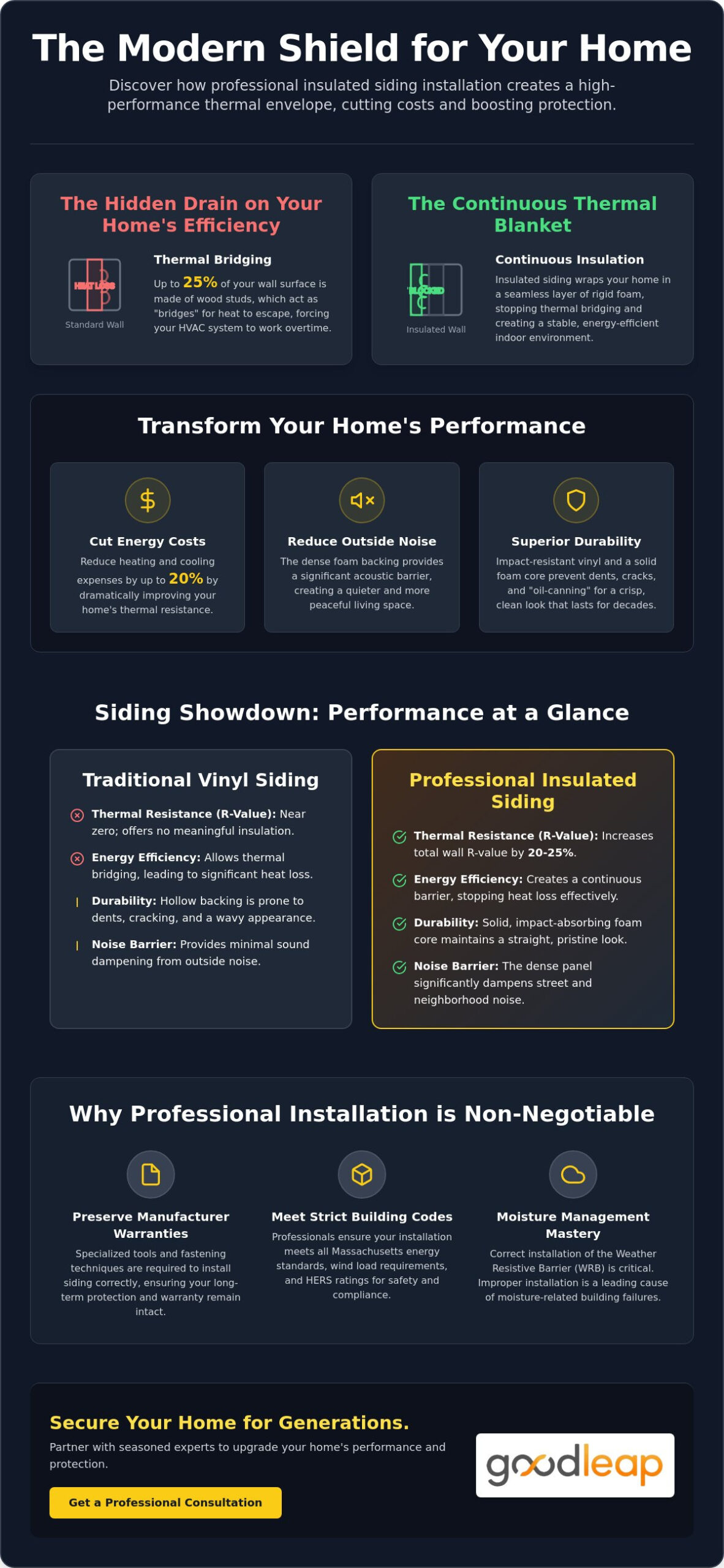
Standard insulated siding installation addresses a major flaw in traditional home construction known as thermal bridging. In a typical Massachusetts home, about 25% of your wall surface consists of wooden studs that connect the interior drywall directly to the exterior sheathing. Because wood is a poor insulator, heat bypasses your wall insulation and escapes through these studs. You can think of it like wearing a heavy winter coat but leaving it unzipped. By adding a continuous layer of foam to the outside of your home, you effectively seal these gaps and keep your furnace from working overtime during a Nor’easter.
The Anatomy of an Insulated Siding Panel
The outer layer of these panels is built from impact-resistant vinyl, specifically engineered to withstand the harsh freeze-thaw cycles of the Northeast. Behind this shield lies a contoured foam backing that fills the gap between the siding and your home’s frame. This design eliminates the hollow sound often associated with cheaper materials and provides a solid, firm feel. Modern panels are engineered with breathable designs. These systems allow moisture to escape from your wall cavity, preventing the rot and mold that can occur when water gets trapped behind less advanced materials.
Insulated vs. Traditional Vinyl Siding
When comparing options, the difference in performance is clear. Traditional vinyl provides almost no R-value, meaning it offers virtually zero resistance to heat flow. In contrast, a professional insulated siding installation can increase your home’s total wall R-value by as much as 20% to 25%. This translates to a home that stays cooler in the summer and warmer in the winter with less energy consumption.
Beyond energy savings, insulated panels offer superior structural rigidity. Traditional vinyl can sometimes look wavy or “oil-can” over time as it expands and contracts. Because the foam backing provides a flat, solid foundation, insulated panels stay straighter and maintain a crisp, clean appearance for decades. They also act as a shock absorber. Whether it’s a stray baseball or a heavy hailstorm, the integrated foam backing prevents the panels from denting or cracking under pressure, ensuring your investment remains protected.
The Science of Savings: How Insulation Stops Thermal Bridging
Thermal bridging is the silent drain on your home’s efficiency. While the fiberglass batts inside your walls slow down heat transfer, they’re frequently interrupted by wooden studs. These studs act as bridges that carry expensive heat directly from your living room to the outdoors. A professional insulated siding installation breaks this cycle by wrapping your home in a layer of continuous insulation. This ensures that the thermal barrier remains unbroken, effectively neutralizing the conductive properties of your home’s structural frame.
This consistent thermal barrier does more than just lower your thermostat settings. It significantly reduces the frequency of your HVAC system’s cycles. When your furnace doesn’t have to kick on and off every few minutes to combat cold spots, it experiences less wear and tear. This leads to a longer lifespan for your heating and cooling equipment. Additionally, the density of the foam panels provides a noticeable acoustic benefit. Homeowners in busy areas like Quincy or Boston often report a significant reduction in street noise, which turns a hectic urban environment into a quiet sanctuary.
Boosting Your Home’s Total R-Value
R-value is a measure of a material’s thermal resistance, indicating how effectively it prevents heat from entering or leaving your home. In the Massachusetts climate, every decimal point counts toward your comfort. While standard siding has an R-value near zero, insulated panels add a meaningful layer of protection that complements your existing wall insulation. This partnership between internal batts and external foam creates a high-performance wall system that meets the rigorous demands of modern energy codes.
Long-Term ROI and Home Value
When it comes time to sell, an ‘Energy Star’ rated exterior is a powerful marketing tool. According to 2026 industry data, homeowners can expect to recover approximately 74.7% of their vinyl siding replacement costs at resale. This makes the project one of the most reliable investments for long-term property value. If you’re ready to see how these benefits apply to your property, it’s a wise choice to explore your siding options with a local specialist who understands the unique needs of New England homes.
The Professional Installation Process: Step-by-Step Precision
A successful insulated siding installation begins long before the first panel is snapped into place. It requires a meticulous approach to the entire wall assembly to ensure that the promised energy efficiency and moisture protection actually materialize. Our process focuses on technical precision that protects your manufacturer warranty and your home’s structural health. By treating your exterior as an integrated system, we ensure that every layer works in harmony to shield your family from the elements.
Managing the extra thickness of the foam panels is where professional expertise truly shines. We meticulously plan the transitions around windows, doors, and gables so the home retains its architectural balance. The Weather Resistive Barrier (WRB) is the most critical component for long-term safety during this stage. It acts as a secondary drainage plane, allowing vapor to escape while keeping liquid water out. Without this layer, even the best siding can’t protect your frame from the moisture-related failures that plague 40% of improperly installed projects.
Phase 1: Preparation and Wall Correction
We start by stripping away failed exterior materials to reveal the substrate. This allows us to inspect for rot, mold, or insect damage that might be hidden beneath the surface. If we find issues, we address them immediately to prevent future structural compromise. We ensure the wall is a perfectly flat, nailable surface, which prevents the “oil-canning” or wavy appearance often seen in substandard work. We also install specialized flashing at critical junctions to direct water away from the frame and toward the drainage system.
Phase 2: Specialized Accessories and Trim
Because insulated panels have a deeper profile, standard accessories simply won’t fit. We use wider J-channels and custom-bent aluminum trim to accommodate the foam backing. This ensures a seamless transition around outlets, dryer vents, and existing fixtures. The goal is to maintain your home’s original proportions while providing a modern, high-performance finish. This attention to detail prevents the “bulky” look that can occur when contractors try to force thick panels into standard-sized trim.
Phase 3: Panel Fastening and Expansion Gaps
New England weather is notoriously volatile, with temperatures that can swing 50 degrees in a single day. We use a “floating” installation technique that allows the panels to slide freely as they expand and contract. Proper nail placement in the center of the slots is essential to prevent buckling or rattling during high winds. Siding panels must be hung from the nails rather than pinned to the wall so they can move naturally during seasonal temperature changes. This floating method is the only way to ensure your exterior remains straight and beautiful for decades.
The final phase involves a rigorous inspection of the thermal continuity. We verify that there are no gaps in the insulation and that the drainage system is fully functional. This deliberate, step-by-step progression prevents the common pitfalls of a rushed job and guarantees that your investment delivers the maximum possible return in comfort and efficiency.
Critical Considerations for Massachusetts Homeowners
For residents in Boston, Quincy, and Brockton, the regulatory environment is just as demanding as the weather. As of July 1, 2025, the 10th edition of the Massachusetts State Building Code is mandatory for all renovation projects. Over 300 municipalities across the Commonwealth have also adopted the “Stretch Code,” which enforces higher energy efficiency standards. A professional insulated siding installation helps homeowners meet these strict requirements by significantly improving the building’s thermal performance, which is often measured through a HERS Index score.
Coastal properties face additional challenges, specifically regarding wind load requirements. In coastal Massachusetts, siding must be rated to withstand higher wind speeds to prevent detachment during Atlantic storms. The rigid nature of insulated panels provides the necessary structural integrity to stay secure when standard vinyl might rattle or buckle. Beyond the wind, our humid New England summers require a sophisticated moisture management strategy. We utilize advanced drainage planes to ensure that while your home stays airtight, it doesn’t trap vapor that leads to structural rot. Pairing a high-performance exterior with durable roofing solutions creates a fully integrated building envelope that stands up to the harshest coastal storms.
New England Weather Resistance
Ice dams are a perennial threat in our region, often caused by heat escaping into the attic and melting snow on the roof. By keeping more heat within the living space walls, insulated siding contributes to a more stable attic temperature, reducing the risk of these costly leaks. Before ice dams develop into a larger problem, it’s worth knowing the signs of leaking roof damage so you can address moisture intrusion before it causes serious structural harm. The materials we use also feature advanced color retention technology to combat high-UV exposure during the summer months. Unlike cheaper alternatives, these panels are engineered to endure the relentless freeze-thaw cycles that often cause traditional cladding to crack or become brittle over time.
Local Permitting and Mass Save Opportunities
Navigating the permit process in Massachusetts requires working with a licensed Construction Supervisor (CSL). This ensures your project complies with the specific “Specialized Opt-in Code” found in communities like Randolph or Stoughton, where homes may need a HERS score as low as 42. While the federal 25C energy credit expired on December 31, 2025, local incentives remain strong. The Mass Save program is currently the primary resource for homeowners, offering a 0% interest HEAT Loan of up to $25,000 for qualifying energy-efficient improvements.
Before you begin your project, it’s essential to verify which local codes apply to your specific municipality. Our team can help you document the efficiency gains required for Mass Save rebates or specialized financing. If you’re ready to upgrade your home’s defense against the next New England winter, contact our local specialists for a comprehensive assessment of your property’s needs.
Why Professional Installation Outperforms DIY Projects
While online tutorials often make exterior renovations look like a simple weekend project, the reality of insulated siding installation is far more complex. It’s not just about hanging panels; it’s about managing a high-performance building system. A single error in panel spacing or flashing can lead to thousands of dollars in repairs later. Professional teams bring the precision needed to ensure your home remains a safe, efficient sanctuary for decades. We focus on the technical details that DIY enthusiasts often overlook, such as the exact tolerances required for thermal expansion.
Cutting foam-backed panels requires specialized tools to ensure clean edges and a seamless fit. Standard vinyl snips often crush the rigid foam core, which compromises the thermal seal at the joints and creates gaps where heat can escape. Beyond the cuts, the most dangerous mistake in a non-professional project is improper flashing around windows and doors. If these water-shedding layers aren’t integrated correctly, moisture becomes trapped against your home’s sheathing. This leads to hidden rot that often goes unnoticed until the structural damage is significant and costly to remediate. Homeowners who want to stay ahead of these issues should familiarize themselves with the critical signs of leaking roof and moisture intrusion that can compound exterior damage if left unaddressed.
The Value of a Manufacturer-Backed Warranty
Homeowners must distinguish between a product warranty and a labor guarantee. Most manufacturers require that insulated siding installation be performed by certified professionals who follow specific, documented guidelines. If you nail a panel too tight or fail to provide the correct expansion gaps, the manufacturer can deny claims for buckling, warping, or fading. Choosing the lowest bid often results in the highest long-term cost when you’re forced to pay for corrections that a warranty would have otherwise covered. Working with established experts provides the peace of mind that your 25-plus year investment is fully protected by both the manufacturer and the installer.
The Powersol Solutions Partnership
For over a decade, we’ve focused on protecting homes across Randolph, Stoughton, and the surrounding New England communities. We understand that your house is your most valuable asset, and we treat it with the meticulous attention it deserves. Our full-service approach means we handle every detail, from the initial site preparation to the final drainage inspection. You don’t have to worry about coordinating permits or managing technical specifications. Instead, you can focus on the results: a beautiful, maintenance-free exterior and lower utility bills. We take the burden of coordination off your shoulders so you can enjoy a stress-free transformation.
Securing your home’s future starts with a detailed plan tailored to your property’s unique needs. Our team is ready to guide you through the selection and installation process with the expertise that only a local specialist can provide. To get started on your journey toward a more efficient home, schedule your professional siding assessment with Powersol Solutions today.
Protect Your Home’s Future and Efficiency
Choosing the right exterior for your home is a decision that balances immediate beauty with long-term performance. We’ve explored how a continuous thermal barrier eliminates heat loss through wall studs and why specialized techniques are the only way to meet strict Massachusetts energy codes. By investing in a high-performance exterior, you’re doing more than just refreshing your home’s look; you’re making a wise financial move that pays dividends in comfort and reduced utility bills for decades to come.
A successful insulated siding installation requires more than just quality materials. It demands the precision of a seasoned expert who understands the unique challenges of the New England climate. As fully licensed and insured MA contractors with over 10 years of New England exterior expertise, we specialize in energy-efficient thermal envelope upgrades that stand the test of time. We take the stress out of the process by handling every technical detail and local permitting requirement on your behalf.
Secure your home with a professional siding upgrade from Powersol Solutions. Your journey toward a more durable, efficient, and beautiful property starts with a single step. We look forward to being your trusted partner in this transformation and helping you take pride in a home that’s built to last.
Frequently Asked Questions
Is insulated siding worth the extra cost in Massachusetts?
The initial investment provides substantial value because it addresses the specific challenges of the New England climate. By wrapping your home in a continuous layer of insulation, you stabilize indoor temperatures and reduce the strain on your heating system during freezing winters. Most homeowners see a measurable impact on their utility bills, and the project typically recovers about 74.7% of its cost at resale, making it a wise long-term financial decision.
Can insulated siding be installed over my old wood siding?
We strongly advise against installing new panels over old wood because it prevents a proper inspection of the underlying structure. Removing the original material allows our team to identify and repair any hidden rot or pest damage before the new layer goes up. This ensures the substrate is perfectly flat and allows the insulated siding installation to integrate seamlessly with your home’s flashing and drainage systems for maximum protection.
How much time does the installation typically take?
A professional crew can usually complete a full replacement on an average-sized home in seven to ten business days. This timeframe includes the careful removal of old materials, necessary wall repairs, and the precise fitting of specialized trim around windows and doors. While weather conditions in the Boston area can occasionally shift the schedule, our methodical process ensures the project moves forward efficiently without compromising on craftsmanship or safety.
Does insulated siding require special maintenance compared to regular vinyl?
You won’t need any specialized equipment or expensive treatments to keep your exterior looking new. While an occasional wash with a garden hose is usually enough to remove surface dust, many homeowners rely on professional services like Poseidon Power Washing LLC to safely maintain the vibrant color and curb appeal of their property. Because the foam backing provides a solid core, the siding is actually more durable than traditional vinyl, resisting dents and impacts while remaining easy to preserve for decades.
Will insulated siding make my home quieter?
The dense foam backing acts as an excellent acoustic barrier that dampens outside noise significantly. You’ll notice a quieter interior environment as the panels absorb vibrations from heavy traffic, sirens, and neighborhood activity. This benefit is particularly valuable for residents in busy areas like Quincy or Brockton. It turns your living space into a peaceful sanctuary by blocking out the distractions of the surrounding urban environment.
How do I know if my installer is properly qualified?
A qualified contractor must hold a valid Massachusetts Construction Supervisor License and carry full liability and workers’ compensation insurance. It’s also essential to confirm they have specific experience with insulated siding installation, as the extra thickness requires specialized cutting tools and fastening techniques. Choosing a team that follows manufacturer-certified protocols is the only way to ensure your labor and product warranties remain fully protected for the life of the siding.
Are there specific colors or styles available in insulated options?
You have access to a wide range of modern aesthetics, including popular board-and-batten and vertical siding styles. These panels come in a variety of deep, UV-resistant colors like forest green and charcoal gray that won’t fade under the summer sun. The thicker profile of the insulated panels creates deeper shadow lines. This gives your home the premium, high-end look of real wood planks while providing all the benefits of a low-maintenance composite material.
What happens if moisture gets behind the insulated panels?
Our installation process uses a specialized Weather Resistive Barrier and advanced drainage planes to manage moisture effectively. The rigid foam used in these systems is designed to be breathable, which allows water vapor to escape from your wall cavity instead of becoming trapped. This proactive approach prevents the structural rot and mold growth that often plague substandard projects. It ensures your home’s frame stays dry and secure through every humid summer and snowy winter.